
Subtleties matter in language. There is a distinction to be made between one thing and another, and we use language to make that distinction clear to others. An example? ‘Point of view’ versus ‘angle of view’ – they mean different things, yes? Or…no? How about the difference between ‘being critical’ and ‘critical thinking’? That seems a pretty important distinction to make; those things are not the same at all, they just take advantage of language by sharing a word. Some differences are about how something feels within us, like ‘irritable’ versus ‘angry’; making that distinction helps us communicate our state of being more accurately to others. Some difference seem more a matter of precision about something outside ourselves, but I’m often unclear on the line between ‘within’ and ‘external’, not due to any particular madness of note, but simply because so few people communicate clearly in language sufficiently precise to account for those nuances – or are unclear themselves on the subtle differences between their internal experience (“this is uncomfortable for me” for example) and their external experience (“this is wrong or impermissible, and being imposed on me” for example). I am learning to listen carefully, and to apply mindful awareness to opportunities to connect and enjoy people in the moment.
It gets complicated when I consider that the words I don’t say have nearly as much impact on other people as the words I do say.
It gets even more complicated when I consider that the tone with which I deliver those words changes their meaning to the person hearing them.
I’m still sort of feeling my way around in the murky shadow lands of good communication, actually. I tend to be strangely ‘face value’ about what people say, much of time. I don’t tend to see/hear subtext very easily, although I can quickly craft numerous alternate meanings or explanations of something said, it’s a very abstract thing. When I have more data, I can be more accurate, but it isn’t really about that other level of understanding for me; I am guessing. Maybe we all are? Those pesky assumptions can really fuck us up!

A journey, a path, a way, an experience.
This has been a lovely few days for beautiful words, too. My partner has showered me with lovely ones, meaningful loving profundities of all kinds, hyperbolic assurances of value, appreciation, worthiness, and fondness. He’s also lobbed a few my way in moments of frustration or hurt that were just flat-out human and mean. I definitely hear the mean part first, and have to fight not to react to that before I catch up with the rest and hear his frustration and hurt; speaking to what is has more value than allowing myself to be chased by my own demons.
Right now, Hardwiring Happiness is the most important book in my kindle. I didn’t realize how little time I was spending really enjoying, savoring, and appreciating the good things, the beautiful words, or the best moments, and how very many minutes I would spend on what hurt, what frustrates me, what makes me sad, what weighs down my heart, or makes me angry – whole hours and days in fact, resulting in implicit negatively bias so extraordinary that I developed a hair-trigger response to frustration that resulted in nasty tantrums, irrational fits of rage or despair, and a lot of irritability because life often felt like it just sucked. I don’t generally feel that way much these days.
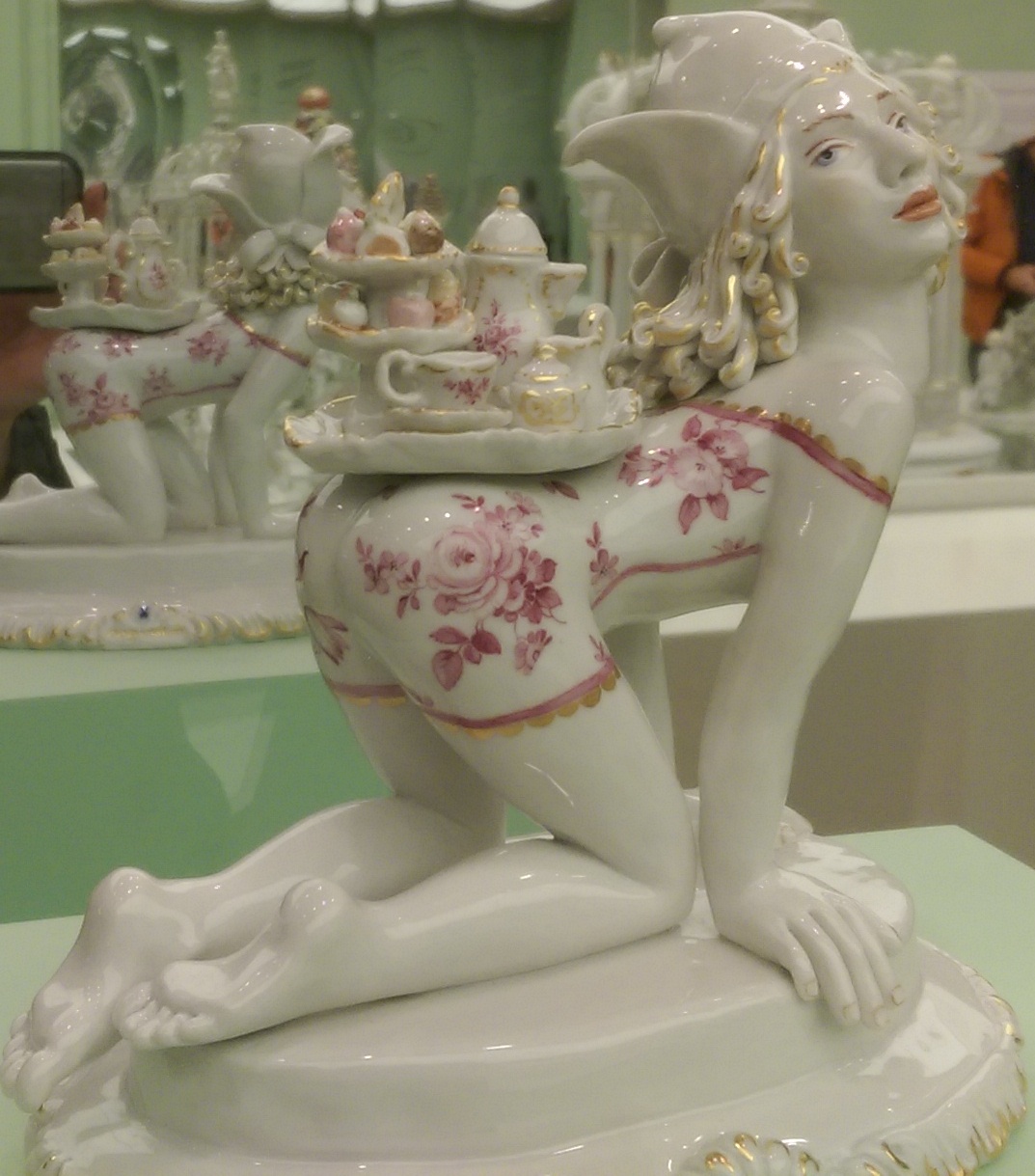
Whimsical porcelain figurine; Meissen on display at the Portland Art Museum.
Words are magical – and not always well-received, or understood at intended. Life’s curriculum is often built on the power of words.
Today is a good day to use fewer words, with more clarity. Today is a good day to use gentle words, with more kindness. Today is a good day to use words with great precision, and great honesty. Today is a good day to change the words.

 Evening Light
I love the word whimsical. I wonder if it’s related to magical.
When I saw the image and read what you were sharing about the varied words you were hearing from your partner, I thought you might be tying in that image to some sort of response you were offering. Not that you’d crawl naked on your knees offering a tea tray. 🙂
Back to the words, I’ve noticed that some times days later someone’s words settle in with me and “click!” I finally get what they must have been trying to get across. I’ve tried and am trying all kinds of listening and communication skills, and it’s worth it.
Thanks for your well-chosen words.
Vincent
🙂 Certainly, there have been moments in life when love inspired such yearning to serve that crawling naked with a tea tray perched on my ass might seem reasonable (lol) but you’re correct; it was more metaphorical. 🙂
I make a distinction between “irritable” (an internal experience I usually describe as “cranky”) and “irritated” (an internal response to an external stimulus). If I’m irritable – or cranky, or in a snit – I’m easily tipped over into irritated, but I’m not there yet. I’m ready, sometimes nearly anxious, to find something vexing, but I don’t yet have a target.
I prefer to let those around me know the exact state I’m experiencing so they can be relieved of confusion about what may have caused my upset. There is no cause; I’m just (“just”) cranky. And most often, my friends express some form of sympathy for my mood, which is enough to lift me right out of that yuckiness, and we can all proceed with smiles.
Once I’ve become irritated, soothing me is not nearly so easy.
Great insights, Jo! I love the subtleties of language!