I woke at my usual time, my usual way. I guess I’m over being sick. I dressed and headed out, eager to walk in spite of the darkness.
[No AI is used in writing or editing this blog. This is human content for human readers.]
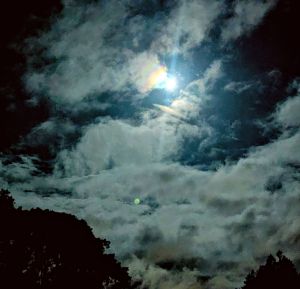
I spotted the full moon overhead as I left the house. It rested on a bed of clouds like a pearl on fluffed cotton. I could still see it as I arrived at the trailhead. It ducked behind the clouds before I could get my camera out to get a picture of the “Hunter’s Moon”. It’s been rainy, I keep an eye on the clouds hoping to see the moon again, as I put on my rain poncho.
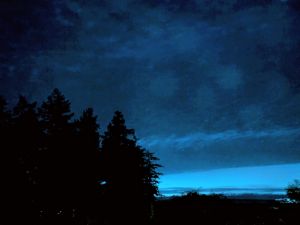
As I set off down the trail, the moon reveals herself. I turn off my headlamp and walk in the moonlight.
Is it a great picture? No. It doesn’t need to be. It’s enough to remind me, later, of this beautiful moment.
I put my phone away, and walk on. As if aware I’m watching, the moon stays out, lighting my way.
I get to my halfway point, grateful that I made it so far, comfortably, after being sick for days. I breathe, exhale, and relax, grinning happily to myself as I recall the pleasant hours in the studio yesterday afternoon – a glimpse of what retirement might feel like. I smile to myself, like I’ve figured something out. I’m not certain I have, but there’s the hint of an idea, and the feeling of having turned a corner, or having set down some baggage. Something to do with the weekend painting on the coast, something to do with painting at home on a weekend afternoon – something to do with making things work in a meaningful way in spite of less than ideal circumstances.
… Maybe I just needed more restful sleep to process things? I’ve definitely gotten that over the past week! 😆
I sit watching the moon pass behind the clouds, then peek out at me again. I fill up on inspiration as I sit watching, breathing, and waiting to begin again. It’s not yet time for that. I meditate and reflect awhile. I watch the moon shining down so very brightly. “Can I capture that luminous glow in pastels?” I wonder.
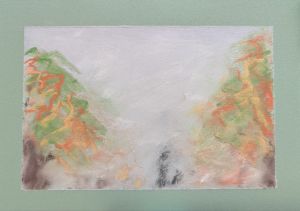
“Foggy Autumn Morning”, 5″ x 7″ pastels on pastelbord, 2026
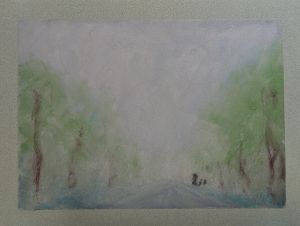
I’ve been painting foggy mornings. Maybe I will paint moonlight, next, after I figure out fog?
“Strangers in the Fog”, 9.5″ x 12.5″ pastels on pastel card, 2026
The moon disappears from view. The dense clouds remind me why I reliably bring my headlamp along. My rain poncho is another welcome addition this morning, as raindrops begin to reach me, sprinkling my glasses with tiny droplets. I sigh as I get to my feet. Apparently, it’s time to begin, again.
I woke later than usual. No alarm. Sunday. I woke feeling genuinely better for the first time in many days. I got up, dressed, and slipped out of the house quietly.
[No AI is used in writing or editing this blog. This is human content for human readers.]
It’s been awhile since my Traveling Partner had a chance to sleep and wake without my (sometimes uncomfortable) presence first thing. I also prefer to wake alone and get myself together before I have to deal with people. Yes, even my beloved. I hope he sleeps in, and enjoys waking slowly.
I’m probably not yet up to a long walk, so I make a shopping list and head up the highway to a favored grocer to pick up a few things. I grab coffee on the way. I take my time with things. This is that delicate time between being ill and being entirely well where a morning of exertion could easily result in a relapse and days more being sick. I am taking my time. There’s no reason to rush.
Autumn is all around. I enjoy seeing the fall colors everywhere. I’m eager to take my recollections into the studio with me and paint thoughts of autumn, seasons, and change. A steady rain has been falling. My arthritis pain is well-managed and not vexing me. Good day to paint.
I breathe, exhale, and relax. I finish my coffee and check my shopping list. It’s already time to begin again.
Being ill during the work week is bad enough. Thinking I might be over it, and discovering just as the weekend begins that no, no I’m definitely not over it, sucks so much more. I slept most of yesterday away, after I got home from work. I slept quite late into the morning (for me), waking to find my Traveling Partner already up, already drinking coffee.
[No AI is used in writing or editing this blog. This is human content for human readers.]
I got up. Stretched. Took symptom relieving medication (I woke “during the night” around the time for my usual meds, and took those then and went back to bed). Washed my face and enjoyed the feeling of cold water on hot skin. I readied myself for the day, such as it is. I expect to spend it mostly just taking care of myself here at home. I went into the kitchen to make coffee, greeting my beloved on my way past him.
…He grumbles about my presence; I’m sick and unpleasant to be around. I take my coffee into my studio…
I ache all over this morning. Maybe from the sickness itself, maybe from being in bed so much over the past… week. Fuck. It’s been a week. No wonder my Traveling Partner was so firm about wanting me to stay home and just take care of myself. This shit has lingered. I take a couple Tylenol and wash them down with my coffee, hoping it helps. Seems a healthier choice that reaching immediately for the big gun Rx pain relief. I remind myself to drink plenty of water.
I’m only half finished with this cup of coffee (which is excellent), and I’m already thinking about going back to bed. I sigh to myself. Definitely still sick. I am glad I ran errands Tuesday, although I was already ill then, and deluding myself that I was “mostly over it”. The errands got done, and I could not have done them on any day since. I breathe, inhaling deeply, filling my lungs. I exhale slowly. I pay attention to my spine, my shoulders, my jaw, observing each notable point of pain (places I know I “carry my stress”), and coax them to relax, each in turn. Another breath. Another exhalation. Another moment to relax. I may go back to bed soon, but I’m in the studio now. That puts a smile on my face that feels like it lights me up from within. I’m not up to much, but painting is not especially physically taxing, these days; I’m set up for the painter that I am now, not that much younger, more limber, painter I was in my 20s or 30s. (I recall with some amusement, painting a rather large piece in acrylic, and just not being able to find quite the right perspective from which to work, until I stood up, looming over it from above. I painted it standing over it, leaning down, legs wide for stability, blood rushing to my head, and managing both balance and control of my brush. I could not do that now.)
I look around the studio. There’s some tidying and set up to do before I can paint, because I took my paints to the coast last weekend. It seems so long ago now. I barely unpacked. S’ok. It’s something to do on a sick day at home that will keep me pleasantly occupied and feel just a bit like I’m doing something, instead of “wasting” the weekend taking care of myself. I sit with that for a few minutes. Why does self-care feel like “wasted” time, this morning? Why did it ever? Why does it now? Do I always experience self-care as a “waste of time”? I don’t think I do. Why now? Is it down to feeling resentful that I’m sick? These fragile mortal vessels are endlessly breaking down over some virus or microbe or injury – but the care needed to restore them to good working order isn’t wasted. It’s utterly necessary. There’s always so much to do in one mortal life. Being ill is what feels most like “wasted” time. I’m annoyed that I’m ill. I have other shit to do.
…And room for more…
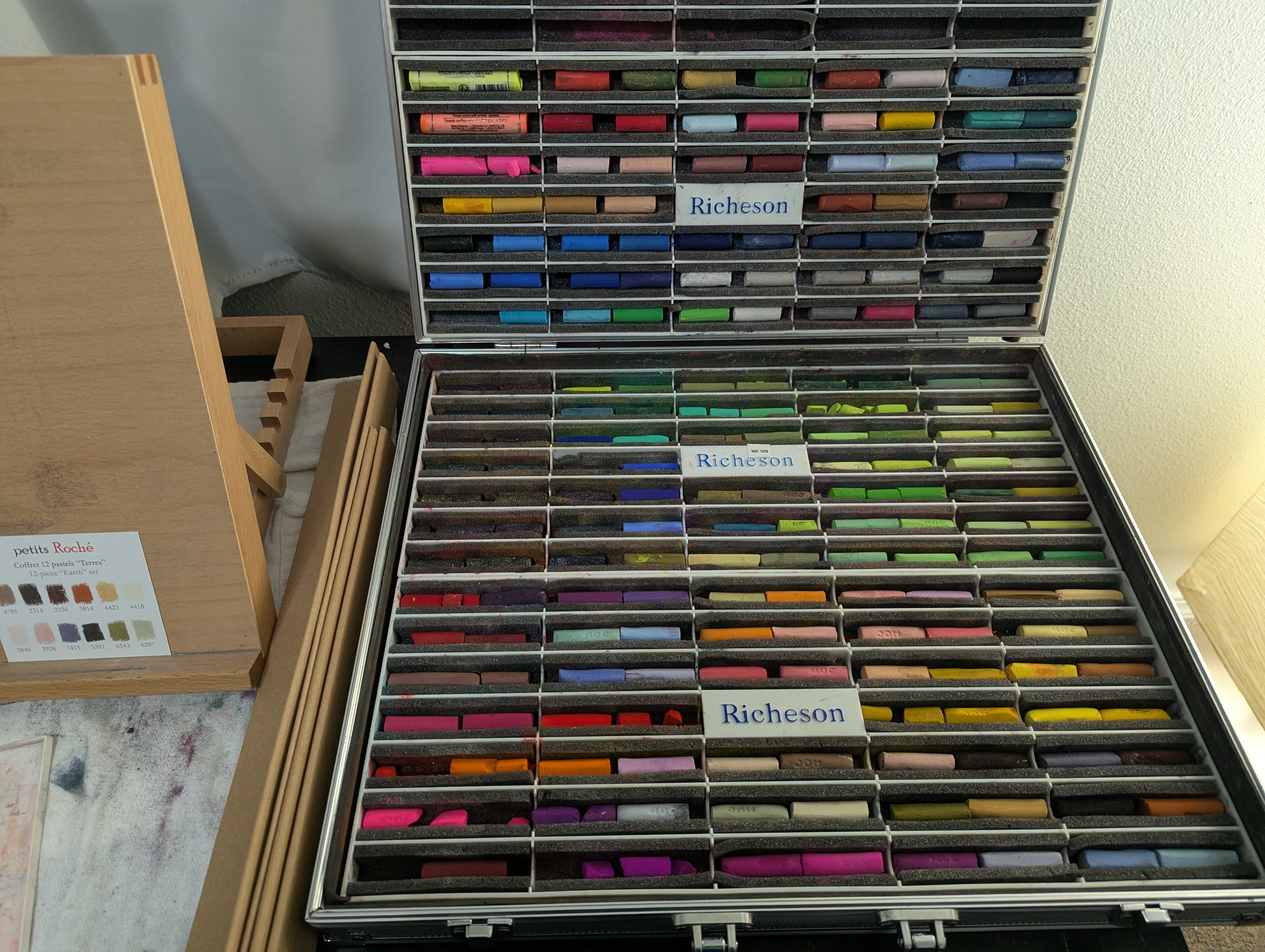
I move around a bit. Set up the easel. Unpack the newly arrived Pastelbord. Put the brushes in their holder (which my Traveling Partner made for me). Unfurl the cotton dishtowels I use to protect surfaces (and other art) from pastel dust. Open the paintbox that holds my precious pastels – so many colors! I sigh contentedly, and for a moment being sick is irrelevant and I’m filled with joy. Odd that a box of colors can create such a feeling of wonder and joy. I savor the feeling while it lasts. (Feelings, like moments, are fleeting, impermanent.) I chuckle at the disarray. I foolishly left my paintbox open as it appears in the picture, and one day it got knocked to the floor by mistake. Pastels went everywhere, breaking as they fell against edges. I didn’t really sort them by color when I picked them up and put them back into their neat slots. I didn’t have it in me at the time.
…I don’t know which is more visually pleasing and artistically inspiring, the mad chaos of colors, or the carefully sorted arrangement by hue. My brain enjoys them differently, I suppose. As it turned out, becoming more used to painting it pastels, it became progressively more clear that sorting pastels into neat categories, rows, trays, color gradations, are all just ways to fiddle with the colors when no painting is going on. It’s not particularly necessary, nor useful (this is an opinion, your results may vary).
I finish my coffee. I finish my writing. It’s clear I’m still unwell. I contemplate going back to bed. I think about painting. The medications have all done their thing…good for what it is, but it leaves me feeling sort of dumb and slowed down, too. I think I’ll give in to that, go back to bed, and begin again later.
I’m feeling better. Enough better to really enjoy a walk in the chilly autumn air before dawn. Refreshing like a cold drink of ice water on a hot day.
[No AI is used in writing or editing this blog. This is human content for human readers.]
It is cold, though. Above freezing, but only barely. I’m grateful for this warm sweater and the fleecy cardigan I added to that as I left the house this morning. The cold manages to feel more refreshing than anything else. I’m glad to resume my morning walk. It just “feels right”. I definitely needed the rest I got from taking a break from my walking for a handful of days. I’m glad I yielded to my Traveling Partner’s strong recommendations that I stay home, get some rest, and give myself a break.
When I am sick, one of the things that is notably impaired is my judgement, along with my impulse control. In other relationships, this has lead to things like me going out in a snow storm to take a city bus to the closest location of a specific fast food chain at my then-partner’s behest, in spite of being feverish and struggling to breathe when I had the latest hideous strain of flu. It sounds ridiculous without any embellishments or storytelling strategies. I was so sick I was having to sleep sitting up – but my fucking partner still sent me out in a snowstorm for a fucking cheeseburger. I very nearly missed the last bus back before the roads were shut down and the buses stopped running completely.
…He complained that the burger was cold by the time I got it home to him…
I sigh to myself. I didn’t even understand at the time that I was being taken advantage of, which still feels more than a little embarrassing, now.
I’m grateful to enjoy a relationship with a partner who looks out for me, now. Being cared for truly feels really good. I’m always looking for ways to return the favor. Partnership; we’re in it together.
The weekend is coming. I’d take off on my own and give my beloved a break from having me around so much while I’m sick, but I did that last weekend. We don’t have it like that. Besides, I’d probably do well not to rush myself back into the full measure of work and busy-ness, immediately. I sit at the halfway point of my walk thinking it over. A short work day today makes sense. Maybe a gentle weekend close to home, and time in the studio, or reading quietly? Coffee with my Traveling Partner, over conversation about our radios, perhaps? Quiet and gentle sounds good.
The cold morning nudges back to my feet. It’s some time before sunrise, and there’s only a hint of daybreak to be seen. I’ve got a busy (short) day ahead… May as well begin again, and get started on it. This path won’t walk itself!
After a pretty poor night’s sleep, I got up early, my usual time. My Traveling Partner woke me, to ask if I would mind going ahead and getting up and starting my day, so he could sleep. I hadn’t slept well, but he hadn’t slept at all. I mumble “sure” and sit up.
[No AI is used in writing or editing this blog. This is human content for human readers.]
I was dressed and gone in 15 minutes.
I was groggy and still a bit stupid as I left the house. I wasn’t sure what I’d do; not yet fit to resume my early morning walks, although mostly over being sick. I stop at the gas station and fill my tank, yawning. I drive to the local trail I favor, and park where the street lights won’t shine in my eyes and nap in the car awhile. I could have taken a seat indoors, at the Big Chain Coffee location nearest me, but I wasn’t up to dealing with people. Not yet. Too early.
My night was fragmented. My sleep was poor quality. The two hours I napped in the car were more restful than most of my sleep that preceded them in the past 24 hours. I wake to the first hints of daybreak. I’m feeling adequately rested, but still not fully recovered from being ill. I yawn and stretch, and give myself time to really wake up.
The food truck that shows up for the construction workers building the hotel on the other side of the parking lot is open for business. I stand in the queue, in the chill of the autumn darkness waiting my turn. A breakfast taco and a cup of coffee, $8.50. The coffee is not quite “bad”, but definitely also not good. It’s strong and it’s hot, though, and it warms my hands through the paper cup. I return to the warmth of the car.
… I’m betting I don’t have a full day of work in me, and mentally juggle the elements of my day with an eye for an early out.
I sigh to myself. Meditate. Write a bit. It’s not a fancy routine, but it works for me. I dislike being sick, it nearly always breaks my routines. Did I remember my computer? Yep, there it is. Computer glasses? Got ’em, no problem. Tissues? Power brick? Yep. I’m ready. I chuckle realizing I did forget to bring along a bite for lunch. I shrug to myself, thinking “it’s always something”.
A new day, a new beginning.
Daybreak comes, a hint of blue at the edge of the eastern horizon. The background noise fills with construction sounds. Machinery. Trucks. Shouted exchanges of information and instructions. I twist in my seat and stretch, as I yawn. The clock ticks on. I hope my beloved is getting the rest he needs.
I reflect for a few moments more, not on any one detail, more on the general ebb and flow of emotions, the changing season, the tick of the clock. I let my mind wander a bit.
I decide to head over to the library, to start catching up on what I missed yesterday. I can even get some work done, using the WiFi there, from their parking lot. And anyway, it’s time to begin again.