Archives for posts with tag: don’t be cruel

I’m sipping my coffee, starting my day, and skimming headlines. It doesn’t take long; the news is filled with non-news about celebrity politicians and the presidential election draws near. I speed along contentedly and largely without stress by allowing myself a jovial mental reply to the headlines – as though a friend said it to me aloud. I move on from there, generally without reading the articles.  Over weeks they have degraded, lacking anything really new to say, becoming strident on all sides, using ‘shout louder’ hoping to gain readers, views, and clicks; reading the articles is already pointless, reading the comments would be a crime against my own humanity.

Skimming the headlines does get me thinking about language. It functions by agreement; differences in our “dictionary”, and thereby our “map of the world”, result in a lack of shared understanding. It would be nice if that were so obvious that each of us routinely would request clarification in conversation (“Would you define ‘liberal’, ‘conservative’, ‘urgent’, ‘required’, ‘necessary’, ‘obscene’, ‘family values’, ‘right wing’, ‘left wing’, ‘terrorism’, ‘racism’,… You see where that could be cumbersome?), but we don’t ask; we assume we share an understanding of common terms. We are routinely deceived or bamboozled when (and because) that is not actually the case. I will walk away from conversation with someone who says “that’s just semantics” when talking about the meanings of the words they choose to use in reply to a request for clarification. It was just such a moment that firmly made up my mind to leave my last job; I can’t work comfortably with someone who expresses the belief that the definitions of the words he uses are not relevant to communication. That’s just… yeah. “Meaning” is sort of the fucking point of communicating… for some of us. For others… well… words can be a shortcut to forcing their will on others, and for those folks, perhaps the actual meaning is less important than the outcome.

Meaning still matters – that it matters is independent of what we choose to do about that. Sort of like reality itself – which gives not one tinkers damn what our opinions are, or what we ‘believe’.

Take a minute and have some fun. How many terms in the prior paragraphs are too loosely defined to be sure that you and I are “on the same page”? 😉
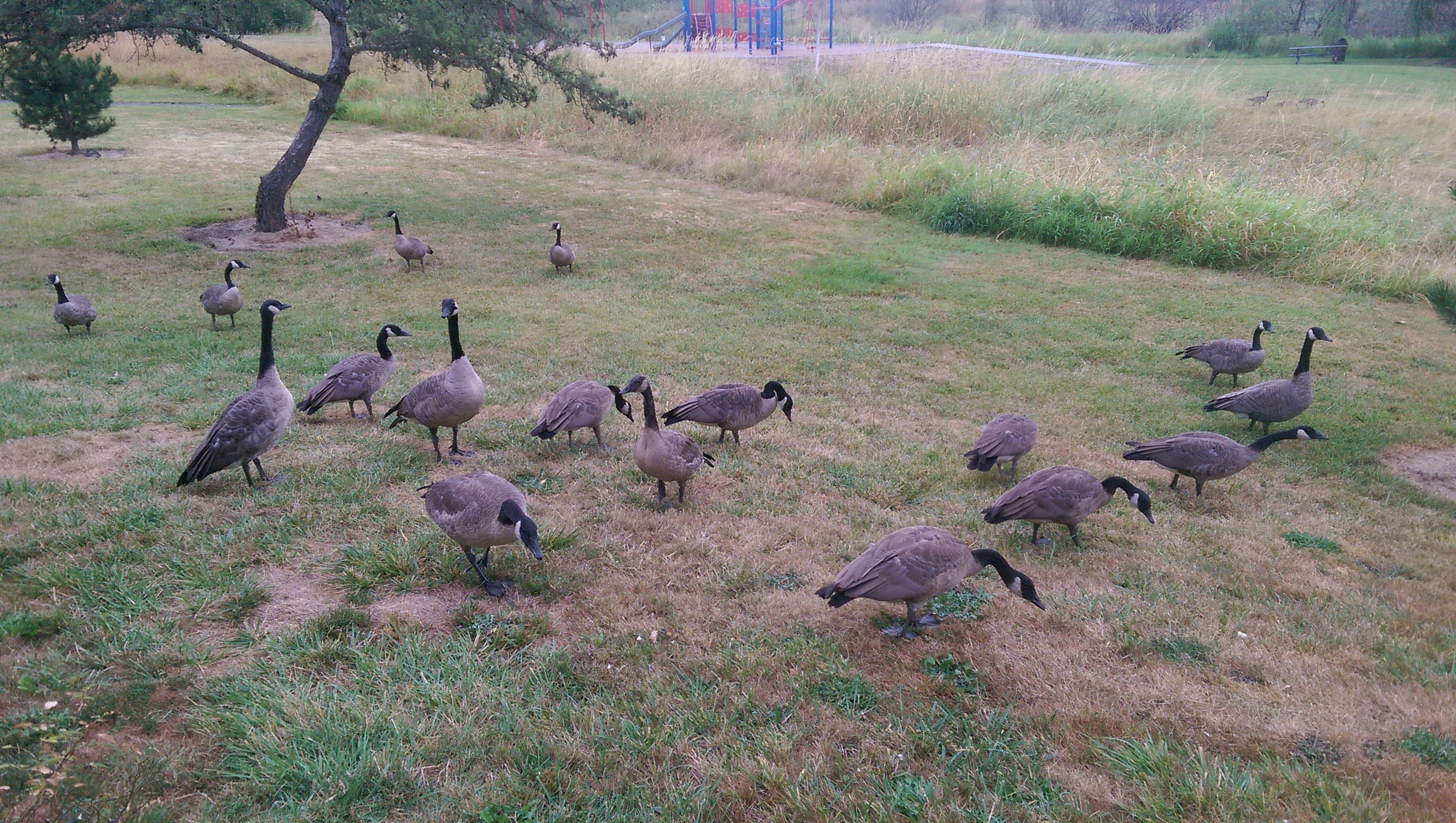
A flock of geese walking by; how do they communication so well?

A flock of geese walking by; how do they communication so well?

I sip my coffee, now-cold in the chill morning air, and watch an enormous flock of Canada geese slow march across the lawn beyond the window. It’s been some weeks since I’ve seen so many, it tells me fall is approaching to see so many.  Is that ‘true’? Does it matter? Well… if I were a feral human in my natural environment potentially relying on a tasty goose to eat now and then, it very well might matter that I understand very well, and quite accurately, their comings and goings. As a suburbanite on the edge of a manicured and maintained not-at-all-wilderness, with a well-stocked pantry, running water, heat, indoor plumbing, and a bit of time on my hands, it’s comfortable to accept their comings and goings as part of the scenery, content with the notion that they are a harbinger of the season changing… maybe they are. My required level of accuracy seems conditional.

I continue to sip my cold coffee – it’s very tasty in spite of having gone cold – and mull things over. There is value in simple language. I like being well-understood. What has value but doesn’t come naturally is worth practicing.

Today is a good day to compare the map to the world; it is of greatest value when the map accurately reflects the world. Scale matters. Perspective, too. Today is a good day to change the map.  🙂

 

Be kind. It’s a simple enough suggestion. It’s not expensive to be kind to people (or animals, or celebrities, or nice things you may have acquired along life’s path). Further, what good reason is there to be unkind? Oh sure, there’s a lot of wiggle room between ‘kind’ and ‘unkind’ that isn’t so clearly defined. Can we accept that both kindness and unkindness are likely active choices or processes, rather than just fumbling along doing and being? If so, and we also recognize that most of us living in the U.S. probably heard the ‘be kind’ message, the ‘play nicely’ and ‘do unto others’ messages pretty repetitively growing up…what the hell is the matter with us as adults? Have you seen the way people treat each other? The nastiness? The negativity? The vicious unending criticism of self and others? The callousness and cruelty built on foundations of self-righteous entitlement and us/them thinking? So…um…if this is our idea of ‘kindness’ or ‘good treatment’ of our fellow man…maybe we would do well to be kinder than that? Seriously.

Sorry. I’m sick with a head cold, and feeling out of sorts. Life’s day-to-day bullshit and drama are more easily tolerated, avoided, or managed more skillfully when I’m not ill. My emotional resilience is limited – and when I’m sick, my default reaction is often anger; I honestly just want to be treated gently, supported, and cared for – because I’m sick.  Of course I’m not alone in that; it’s spring, and the second significant wave of illness has hit the area (there’s ‘flu’ season, then just as spring gears up, we often see a major short-term increase in people out of office with colds).  I’m pretty sure I picked this cold up either in the office or on the commute. (Cover your coughs/sneezes, people, please!) Hell, I’m not even the only person in the household who is ill this week.

Here’s the thing about kindness that I notice most often; people aren’t doing it. A lot of people, totally not investing even the slightest effort to be kind, and instead actively investing will, intent, emotion, time, choice, and action into treating people poorly – not just any people, the people they say matter most! I regularly see or hear people being total dicks, seriously hurtful and unkind, to friends, lovers, even family. What the hell? These are people we care about? What’s the thinking there?

What does kindness really look like?

What does kindness really look like?

I’ll take a real-life example – a stranger from a recent bus ride – to illustrate. A woman gets on the bus, she is on a phone call. She is talking very loudly, and it is not possible to avoid overhearing every word of her phone call (at least her end of it). So, okay – that’s our first moment of unkindness; she seemed utterly unaware that this behavior could be disruptive or unpleasant for other passengers at all. As the call progressed I learned way to much about her, but it fuels the writing this morning. 🙂 She was angry, and venting to a friend about her resentment that her current lover expected her to shower before sex (note, this is happening late in the afternoon on a Wednesday) and observes “I just had a shower on Sunday morning, and it’s not like I’ve had sex since then!”. I’m struck by her resentment… we live in a pretty hygiene conscious society, and my own perspective in this context was to feel just a little shocked that she’d admit to ‘being so nasty’. lol (I am aware that different standards exist in other cultures, and that the frequency of bathing in other circumstances could reasonably be quite different.) She goes on from there to rant about his many other lovers that she is sure exist, and all manner of vengeance she is inclined to enact due to the existence of these other lovers. The conversation continues. In the space of a few minutes she rather self-righteously exclaims a variety of fairly criminal acts to be within reason for her, in her circumstances: stealing her lovers phone to go through his address book without his consent, contacting people she doesn’t know to say derogatory things about him (specifically untrue, and she’s quite clear about that, too), physical violence against her lover or his potential lovers, arson, homicide, assault, gas-lighting, stalking… and all delivered in a tone of utter self-righteous entitlement, and clear anticipation that her position is rationally supportable and justified. It was actually pretty  horrifying to listen to. I could not help but wonder why anyone would have sex with someone who would say such things about them, or potentially behave in any of those ways! She directed an equal measure of implied invective toward herself stating assumptions about other women with similar characteristics reflecting her self-defined short-comings, and the imagined advantages held by women of others sorts. (She was very concerned about the weight of her lovers potential paramours, and made it clear that ‘skinny girls don’t have these problems’ – which goes well beyond any acceptable lack of social awareness for an adult, I think.)

Am I gossiping? I hope not… I am also doing my best to avoid being (or sounding) judgmental… I’m trying to get around to making this point; be kind. Treat yourself and others well. Sure – but if you don’t understand that being loud on a cell phone on the bus is unkind to other passengers, will you know not to do it? If I don’t understand that making threats of violence when I am angry is unkind to people for whom that level of acting out causes anxiety, will I know to work on handling my volatility differently? If we live in a culture where we regularly see people treated as property, will we understand that people are not property – and that assault and arson are not appropriate responses to another human beings sexual decision-making? That it isn’t okay to kill people because we’re angry with them? The woman on the bus very clearly believed in her cause, and that she had been wronged, and that any action she might take to redress that wrong would be acceptable – who taught her that? Who taught her that her lover becomes her property because they have a sexual relationship? Who taught her that someone else’s needs are of less importance than her own? It really got me thinking about me – about what I do or don’t expect from people, and what I find appropriate day-to-day – and why. I can do better, day-to-day, to be kind. I can’t find any reason not to.

Many years ago I was admittedly not particularly concerned about kindness. I didn’t ‘get it’. (Righteous rage doesn’t make much room for compassion or kindness, honestly.) I think about kindness a lot now. I am not able to make a good argument against being kind – but I see a lot of ‘traps’ along my journey; it is tempting to rationalize very good sounding reasons to exclude one person or another from being treated with kindness. It isn’t easy to maintain kindness toward others when I’m having a difficult moment, or feel angry at that person I am tempted to be unkind towards. It is sometimes difficult to be skillful at not permitting myself to be taken advantage of or treated badly in the face of kindness; I know I have much to learn, and I also know that kindness is possible without sacrificing good self-treatment, consideration, and self-respect, too.  Life’s curriculum is rich, complex – and rewarding. I am still a student. I am still a beginner. “I am only an egg.”

What does it take to build a beautiful life?

What does it take to build a beautiful life?

Today is a good day to be kind. It’s also a good day to be kinder than that. It’s a good day to take being the woman I most want to be to another level. We are each having our own experience; a kind moment might be all that other person needs to thrive. It’s a good day to be the change I wish to see in the world.

I like communication. I think most of us probably enjoy it, or some aspect of it. My favorite, as much as I enjoy words and talking and writing, is being heard.  I’d be surprised in that weren’t true of most people, but I’m not ‘most people’ in a lot of ways, so I likely shouldn’t go out on that limb. 🙂  I do enjoy being heard, however I have a lot to learn about listening; this is another statement I suspect is true of a lot of people, just based on observation.

It is a journey taken one step at a time.

It is a journey taken one step at a time.

I’ve noticed something strange…people who don’t feel heard are generally not listening (at least at that point at which they feel they are not being heard, themselves).  “Communication” so easily turns into tit-for-tat bullshit that there are actually enough books written about communication as a subject to fill a library without help from any other topic. Amazon has 339,665 books on “communication” across a variety of subtopics, such as “communication skills” (very popular, right at the top) and “law” (which I suppose gets involved when communication goes seriously awry).  Human primates work hard to communicate – hell, we created language to facilitate that! We consider both verbal and non verbal forms of communication when we discuss language, and make a big deal over one versus the other, and when it is appropriate to use them, and how to interpret them. We make rules about communication and set up hierarchies of information to sort fact from fiction, lies from well-intended misstatements based on erroneous beliefs, and novels from religious tomes. Us versus them. We get our emotions involved. All that fuss and effort – and we’re still communicating poorly, and taking shit personally based on untested assumptions, and expectations that source from fictions in our own heads.

Part of my own challenge in communication rests on the distinction between ‘hearing’ and ‘listening’. You, too? Have you ever been in a heated discussion, or contentious meeting, and rather than actually listening with awareness to the speaker of the moment, you were investing time in formulating a reply – to something you heard moments ago, or something you are only half listening to in the moment? It’s a poor practice. I can make that assertion comfortably, feeling pretty sure you’ll agree with me – all I have to do is make that observation from the vantage point of the disregarded speaker, themselves. We’ve all been there – making a point that matters to us, doing our best to be clear, concise, and hold the attention of our listener, and… aware that we are not actually ‘being heard’; the vaguely distracted facial expression, and loss of eye contact, or lack of focused gaze, are a hint – the real giveaway is when our listener begins to reply or rebut, and it is apparent they are not speaking to the salient points at all, they are just downloading what they spent time considering – while you were talking. They weren’t listening, they were waiting for their turn. Awkward. Rude. Ineffective communication. It’s so easy, though, to get wrapped up in what feels like matters the most – and lose awareness that what actually matters most is listening while someone is talking.  It gets more complicated if the person talking is an unqualified asshat, I get it, or espousing views that are “offensive” or inflammatory. That’s hard to take. Perhaps in that scenario the more effective communication is to say frankly that there is offense, or express clearly and simply that the information is in some way unacceptable – then disengage without further rebuttal or reply? (Is every battle mine? lol I’ve been making some different choices, lately, myself).

Deceit, treachery, willfully misleading someone, treating them poorly or bullying them with language; my perspective is that these things are not good uses of communication between honorable beings making compassionate choices, and treating people well. We don’t always make our best choices in the moment, though, do we? It’s easy for a person, in a moment of anger, to be willfully cruel, or in a moment of frustration to be impatient or callous. We’re all very human.

I dislike imprecise communication, particularly regarding emotion. I’m not always good at it, myself, and I practice some things I find key, and I do so in a very planned and studied way. The things I put that kind of structured emphasis on are simple enough. I practice communicating willfully in words – for me this means moving gently through physical space, and not using my body to communicate strong emotion instead of using words; no deliberate slamming or banging of cupboards, doors, drawers, etc to communicate distress or anger. It’s very upsetting and imprecise, and it tends (in my own experience) to foster panic, anxiety, and insecurity in the human herd without truly communicating anything with accuracy, or honesty. It seems mean, and it causes considerable extra wear and tear on household goods.  (Do you slam shit when you’re mad? Why do you do it? What does that satisfy for you? I’ve been there, but I can’t say I find anything of lasting value in that method of communicating; I gave it up in principle some time ago.) I won’t claim any mastery; I practice continuously whether I am upset or not.  The other key practice is listening, really attending to the words another person is taking time to share with me, without being distracted by the pressure of my own desire to speak and be heard, or caving to some need-in-the-moment to challenge or disagree. It’s very difficult for me – the disinhibition issues I struggle with often get in the way; practicing is very important for reinforcing better habits. Not interrupting people is a good start on a basic level. (I am so not there yet! I work at it every day.) It matters that much to me, that people speaking with me feel heard.

It was slow going to reach a place where I understand that because I desire to be heard, learning to listen is critically important. It was also a struggle to reach a place where I understand that communicating emotions is not about pushing the visceral experience of strong emotion into the consciousness of other human beings against their will, or without their consent; it is about using gentle words, clearly and simply, while allowing that other consciousness to continue to have its own experience. There’s a lot of practice ahead of me. The day I realized I am practicing these qualities and behaviors because they are who I want most to be – and by intention, who I am – I became so much more able to step back from frustrations built around ‘I will when they do’ and ‘they don’t so why should I?’ or issues of unfairness, and suddenly I felt more heard – because I am listening to my own voice. That matters, too. So often it has turned out the person not listening to me, is me.

Savoring each precious moment through awareness is a nice place to start a journey of discovery.

Savoring each precious moment through awareness is a nice place to start a journey of discovery.

Some rambling notes on communication early on a Tuesday morning. It’s a good day to communicate with love, and with great attention. It’s a good day to really hear the message I am sharing with the world, from the world’s perspective. It’s a good day to be kind, and to treat others with courtesy – not because they deserve it, but because it is who I am. Today is a good day to change the world.

My commute home last night got me thinking about The Big 5 again: Respect, Reciprocity, Consideration, Compassion, and Openness, but last night, mostly Consideration.

Every open door is another opportunity to choose well.

Every open door is another opportunity to choose well.

I was struck first by how tired everyone looked. Well, sure, end of the work day, that makes sense; we’re all tired and eager to go home. What I saw next in so many faces was the sheer force of will it took to refuse to consider others.  A lot of faces, a lot of commuters, each actively engaging in processes of mind intended to sooth themselves and justify decisions to hang on to their seat, their spot by the door, the empty seat next to them, or whatever ‘win’ they scored on that trip that evening on that crowded commute. I saw a well-dressed business man, younger than me – late thirties, perhaps – steadfastly refusing to make eye-contact, or even look toward, the pregnant woman standing in the aisle next to his seated self. She was obviously very uncomfortable, and not quite tall enough to easily reach the dangling handles. In fact, not one of the healthy fit adults in the train car offered her a seat. Nor did they offer one to the elderly woman a few steps further down the car. They didn’t offer a seat to the harried mother of many little ones trying to keep assorted toddlers and a tween in check on her journey. Some of the seated commuters are ‘regulars’. I see them each day. They occupy their seats with a certain firmness, as if to say “this is my train, my journey, I do this daily and I have earned this seat.” There was also an assortment of woefully inconsiderate teens, just out of school activities for the day, and while I don’t excuse their callousness, their age makes it less mysterious, and less offensive. Yes. I am offended by the invested disregard for others that so many of us fall into as adults. I’m not judging, as much as observing with a certain sadness, and empathy. I used to be that entitled, self-satisfied, resentful, callous adult grabbing a seat on the train with a certain smug determination, and a sense of possession, and boundary setting.  My stomach churns bitterly and becomes a tight lump of something unpleasant settled inside myself when I acknowledge it honestly. It sure isn’t the best I have to offer as a human being. It definitely is not considerate.

What about last night? I stood for the commute. Why not? I’m not the strongest, youngest, fittest, or healthiest commuter along the route on most evenings, but I get by, and the courtesy shown when I can offer my seat to someone who needs it more than I do is an enormous investment in a very different feeling about life, about people, about the value in our shared experience. It matters.  I reflected on simple courtesy, and my Big 5, all the way home. There will be other commutes, and new opportunities to reflect on The Big 5. Consideration is a tough one to define, and might be the most important one, when I view ‘Considerate’ as ‘consider it’… isn’t that what it comes down to? Considering things fully? Taking a moment to consider that the woman or man standing nearby may have needs? May be in pain? May be suffering a moment of great sorrow? May need to get off their feet for even a minute or two on a rainy night? May feel alone, burdened, and unsupported? How many of my own worst moments of behavior come down to simple lack of consideration? What about yours?

I’m also keenly aware of ‘bystander effect‘. Last night I wrestled with understanding where the line between ‘doing the right thing’ and ‘meddling’ really is. If I ask someone else to give up their seat for someone who clearly needs it, am I ‘meddling’? Am I diminishing the personal authority of the person I intervene for? Am I being inappropriately critical or judgmental of the individual of whom I make the request? Are the answers to these questions easy for you? (I find them a challenging puzzle.) Culture changes over time. It once seemed a little silly that the buses and trains have signs and announcements reminding people to give up their seats for the elderly or disabled. It now seems obvious and necessary to make such reminders; we are not a considerate culture.

Today I will explore ‘consideration’ all day long. I will pause to ‘consider’ my actions and choices as often as I can remember to do so, and really consider the indirect outcome of my actions, not just the planned or desired outcome. Kindness is a free service. Compassion presents no inconvenience – and can as easily be learned.  What about you? Feel like helping me out with making the world a friendlier, easier place to enjoy life? Will you take a few moments, an opportunity or two, to be more than usually considerate? If you do, I’d love to hear how it goes!