
Archives for posts with tag: Wheaton’s Law

I am sipping my morning coffee (it’s good). It is the morning after Giftmas (it was lovely). Our holiday dinner was delicious (and ample). I am feeling fortunate (and grateful).

I slept better last night than I really expected to. My guts were churned up, rebelling against a “brunch” entirely of chocolate and coffee yesterday, followed by a heavy fairly rich meal at dinner time. I woke a couple times feeling a bit uncomfortable, not quite unwell. It passed. I even slept in a bit, and woke feeling pretty good generally, although aware of my arthritis in the background, and still bruised here and there from my fall on the deck on Giftmas Eve.

I haven’t made a firm plan for today. I probably ought to go to the grocery store… I’m not sure I feel like going out at all. I’m also not sure I don’t. Coffee first. Maybe some time reading by the fire? I am thinking about The Four Agreements. It was first suggested to me by my Traveling Partner. It’s clear that the recollection of them still exist in his thinking. Occasionally, he “calls me out” when I fail to practice one of them in our interactions together. I try to process such things as useful feedback, rather than kick up a fuss about it.

I’ve gotten a lot of really useful practical wholesome insight from The Four Agreements over the years, since I first read it in… 2010?

We have learned to live our lives trying to satisfy other people’s demands. We have learned to live by other people’s points of view because of the fear of not being accepted and of not being good enough for someone else.

Don Miquel Ruiz, The Four Agreements

Here’s the simple truth of everything we learn, and everything we do; we become what we practice.

Practice being calm? We become calm individuals over time. Practice being kind? Kindness becomes a hallmark of our decisions and thinking. Practice lifelong learning? We become educated as we gain knowledge. It is seriously that “simple” to change who we are, if we choose to do so – it’s a matter of practice, and time.

…Here’s the thing, though…

If we practice being angry? We become less able to manage anger appropriately (we become angrier more easily, more often). If we practice aggression? We become more aggressive. If we practice lashing out at others in moments of stress? Yep. You’re catching on; we do more of that, more often, more quickly – we get really “good at it”.

We each have the tools of change in our possession. We have more control over who we are (and therefore also more responsibility) than we may like to acknowledge. Doesn’t mean the journey is always easy. Doesn’t mean we’re in this alone. We live within the context of our circumstances, our relationships, our triggers, our biases – we are human. Personally, my own thinking on that is that this gives me choices – who do I most want to be? How do I practice that? My emotions may be a reaction to my experience, to the world around me, or to a person with whom I am interacting, but that doesn’t get me off the hook for managing those; they are mine. If I practice having tantrums? I will have tantrums. If I practice calm reflection and deep listening? My reaction to the world around me becomes characterized by calm, and consideration. Because I am so human, avoiding provocation can be quite difficult – but I know that even this is about practice. Like it or not, human primates are not entirely domesticated and can be dangerous under some circumstances… we really only ever “have control” of one of them – the one in the mirror. Limited control at best, too. Our practices matter.

It can be hard, sometimes, to practice The Four Agreements. They seem so easy, and I suppose they are easier than a lot of things – they just take practice. Rather a lot of it. (Worth it.)
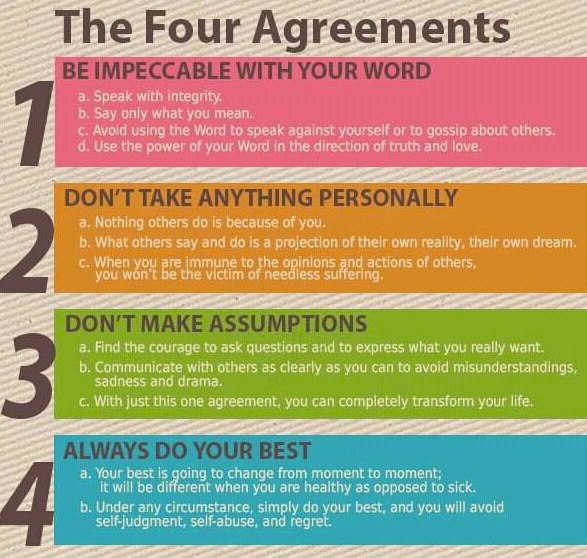
It can be hard to practice The Four Agreements (or frankly, any personal growth practice) if someone I interact with routinely doesn’t share the basic values or at a minimum respect what I am hoping to do by practicing them. It’s harder still if there is someone in my day-to-day social group or community actively seeking to undermine my progress or growth. Over time, I’ve cut quite a few people loose who seemed invested in the most broken possible version of me. I think that’s the healthiest approach to toxic relationships; end them. That comes up in The Four Agreements, too:

If someone is not treating you with love and respect, it is a gift if they walk away from you. If that person doesn’t walk away, you will surely endure many years of suffering with him or her. Walking away may hurt for a while, but your heart will eventually heal. Then you can choose what you really want. You will find that you don’t need to trust others as much as you need to trust yourself to make the right choices.

Don Miguel Ruiz, The Four Agreements

The new year approaches. I’m thinking about who I am, who I most want to be, and what practices keep me on my path. We become what we practice. I smile when I think of how many times I have said that, written it down, read it back to myself – it’s a core idea (for me) in becoming the woman I most want to be. Beginning again is just a beginning (obviously) – it’s that stepping stone to the next bit of practice. We become what we practice. It’s not avoidable or negotiable. It is inevitable. Practice something – anything – long enough and it becomes characteristic of who we are. Good or bad.

Everything you have ever learned, you learned through repetition. You learned to write, to drive, and even to walk by repetition. You are a master of speaking your language because you practiced.

Don Miquel Ruiz, The Four Agreements

So… here’s a question that matters… What are you practicing? What effect does who you are have on the world around you? On your relationships? On people you say you love? Are you the person you most want to be? Maybe it’s time to reflect and make some changes to your practices?

Maybe it’s time to begin again?

I’m on my third coffee this morning. I slept poorly. My Traveling Partner slept poorly. I slipped away early in the morning hoping he would be able to get some better sleep, but that didn’t work out ideally well. I am sitting in the studio, drinking coffee and considering the causes and the potential outcomes, and wondering how best to be helpful.

“Being considerate” may very well be one of the most powerful skills (and practices) that a person can bring to social relationships (of all kinds). I have found it sometimes a bit difficult to define “consideration” – in spite of placing it high on my list of things to look for in relationships. I see people who are “considerate” practicing deep listening, explicit expectation-setting, skillful boundary setting, asking clarifying questions, testing their assumptions, yielding their natural desire to be “right” preferring to be kind, making an explicit effort to refrain from “centering themselves” in every circumstance or conflict, and being very comfortable making a prompt apology when another person points out a transgression. That seems like a lot to manage, but it really does all map to “consideration” – as in, genuinely considering what those around them are going through or may need.

Let’s be clear on one point; I don’t see considerate people being doormats or open to being abused or mistreated. They use boundary setting and expectation setting with great skill and comfort. They consider their own needs along side the needs of others, and make a point of practicing good self-care, too.

Lacking fundamental consideration leads people to casually mistreat others without intention – and often without noticing, and sometimes following-up by callously doubling-down on that mistreatment by attempting to deflect blame (by way of excusing their actions as “unintended”). Doesn’t really “make things right” to do things that way, and feels still more inconsiderate. People who are inconsiderate are by far more common than people who are considerate! It has become socially “normal” to see (or have to accommodate) inconsiderate behavior from others. People are busy. Self-involved. Dealing with their own shit. Struggling to heal trauma. Uneducated about the impact their choices/words/behavior has on others. Unaware how much difference consideration can make. There’s a lot going on with inconsiderate people. Most of it is even shit everyone has going on in life. One thing that isn’t going on with inconsiderate people; they are not being “considerate” (probably a huge timesaver, I don’t know…).

Consideration and considerate behavior isn’t “natural” to human primates; we learn it from our social group(s) – and therefore must teach it to our companions, explicitly. Children generally get taught “sharing” – a part of consideration. Every element of consideration probably needs to be explicitly taught. As a culture we’re clearly falling down on the job, there, based on the general rise in inconsiderate behavior, basic rudeness, and prevalent violence. I’m pretty certain that very considerate people are likely less prone to violence. It’s something to think about.

Today, I’m struggling with “my nature”; I tend to be very considerate (of others), but also tend to fail myself on the self-care and boundary-setting side of things. Knowing my Traveling Partner did not sleep well, I consider what I can do to be helpful, or to at least minimize the potential for stress or conflict in our relationship due to the both of us being fatigued and in pain. It’s complicated. What does he need? What does he want? Can I provide those things? Is guessing at them wise? What about me? What do I need, myself? Can I meet his needs and my own? When do well-intentioned inquiries about what he needs become invasive or pestering? How do I prevent my own boundary and expectation-setting needs from being swept aside in the pursuit of a gentle day together (under difficult circumstances)? What is reasonable, and what is excessive? How far do I take “not taking things personally” before it becomes entirely necessary to “push back” or point out a boundary – and how do I do that gently enough to also avoid sounding “bitchy” or unreasonable?

My anxiety simmers in the background, and that’s not at all helpful. Consideration, like “mindfulness”, is something that takes quite a bit of actual practice (at least for me). It’s not my “default” human behavior. It is, however, something I value quite a lot – enough to keep practicing. Enough that it matters to achieve mastery – and balance.

It’s a new day. There are opportunities to be a better person than I was yesterday. There will be verbs involved, and practice required. My results will no doubt vary. It’s a good time to begin again. 🙂

I’m down to the end of this cup of office coffee, here in the icy chill of the co-work space. (Seriously? It’s summer, it’s okay if the office is 75 degrees, instead of 67! It’d still feel cool. LOL) There’s so much angry shit in the news, so much violence, and generally bad behavior. It’s hard to fathom how so many people can take the actions they do, say the things they do, treat each other the way they do. Why is there so little practical effort to “make the world a better place” – most particularly by the people making it bad to begin with?!

We could all do better, I’m sure. This is not an “us vs them” thing; we each have opportunities to do better, with regard to something. This isn’t about “left vs right”, either – there are some shady “bad actors” on the left and on the right. There is a seemingly endless uncountable number of misogynist racist xenophobic ass clowns just… every-damned-where trying to rationalize or excuse their bullshit (or force it on the rest of us). It’s pretty horrible, and I’m frustrated and saddened by it.

I’ve heard that if I’m inclined to complain, I ought to come with a solution to propose. I’ve got you. No problem. Here it is; practice Wheaton’s Law. Every day. All the time. Reliably. Everyone. Simply that. If everyone really did embrace Wheaton’s Law to guide their day-to-day interactions, I suggest that that world would be a far better place than it is right now. Just saying. Do better.

…Yes, you, too. Yes, me too. Just do better. Be a better human being today than you were yesterday. One interaction at a time. Practice. Sure, your results will vary (I know mine do). It’s still better than just not doing a damned thing about human misery. Do something. Some small thing.

Practice Wheaton’s Law.

Begin again.

Friday. Already? Time to think about the weekend… that’s nice. It’s been a good week. Productive. Chill. I can’t bring a moment of real stress or conflict to mind (in my own right-here-right-now experience of living life). It’s a nice pace to be, poised on the edge of a weekend, without a complaint or grievance. 🙂

…What to do with the weekend, though…?

I’d like to get a couple miles on my hiking boots tomorrow – maybe run up the road to the wildlife refuge and walk the loop there? Work my way back errand by errand? Sounds like fun. Housekeeping Sunday.

Last Sunday my Traveling Partner encouraged me to just “take the day” on Sunday instead of my usual housekeeping and whatnot. It was soooo good to relax that way. We did a couple things together (projects in the shop) and I relaxed. Properly. It was very restful. At some point during the week, my sleep went to shit and by last night, I was kind of stupid with fatigue and sleepiness, and as wobbly getting around as if I’d had several quick shots of rum. My Traveling Partner encouraged me to go ahead and crash – it wasn’t even 5:30 pm at that point. I didn’t think I’d sleep… he woke me hours and hours later to hang out for a little while before he considered calling it a night, himself. I probably could have slept all night, but it wasn’t what I’d wanted to do when I did lay down hours earlier. I’m still astonished that I crashed so hard, and slept so deeply. I had no difficulty returning to sleep a bit later, and woke quite on time this morning, feeling wholly rested.

I yawn, thinking about sleep, later, and smile, thinking about how nice it is to feel so loved, now. It’s a good place to be.

Tomorrow? Another mile on these boots. For now? Love is enough. 🙂

I can’t even string together enough swear words to adequately describe the pain I am in this morning. It’s just physical pain. It’s even mostly the “healthy pain” of spending a day working in the garden, stooping, bending, lifting, digging, kneeling, standing, reaching… all good stuff. Fuck I hurt though. That pain on top of my arthritis, on top of my [whatever the fuck is wrong with this bullshit] neck/headache pain – it’s a lot. I’m sipping a very good cup of coffee this morning, working on shrugging off the pain, to get started on the Sunday routine – housekeeping, chores, upkeep. The details of having good quality of life do not take care of themselves. (Note: if you think that the details of having good quality of life “just sort of happen”, then I suggest you look around for that person who is clearly caring for your clueless ass and say “thank you” once in a fucking while, and oh yeah – how about helping out?)

It was a lovely day in the garden, yesterday. There’s more to get done (I didn’t quite finish, even with my Traveling Partner’s help): there are yet a handful of dahlia tubers to plant, some final tidying up of beds (for this go ’round), and tools to put away. I enjoyed the work, and the effort. I am pleased with the results. I focus on those things, and turn my attention away from the pain I am in. That, and good self-care now, are the best I can do. Some yoga and pain management first thing when I woke, and hopefully once this coffee is done, I’ll be in fair shape for the chores ahead.

If you’re reading this as a healthy fit twenty-something, feeling immune to the aches and pains, and possibly just the tiniest bit dismissive or smug about your fitness, I have only this to say; your turn will come. 🙂 I don’t mean in a harsh way, I’m just saying that I understand that you “don’t get it” – we don’t know what we don’t know. I didn’t get it in my twenties, either. I couldn’t. It was outside my ability to truly understand. Enjoy ease and comfort and freedom of movement while they last you, my healthy fit friends of all ages. We’re all at risk of losing that fitness – whether through age or adversity – and once it is gone, it can be damnably difficult to get it back. (I keep working at that. Slow progress is still progress.)

Be kind to people. It’s unlikely that we know what someone else is really going through – even if they do try to tell us. Our own pain is typically the worst pain we know – and if it “isn’t that bad” we may not have a real reference with which to understand what someone else is going through. That’s as true for me as for anyone else. My partner tells me when he is in pain. I tell him. We hear each other. We earnestly seek to support each other with real care and consideration. We still can’t really know the pain the other one is experiencing. How bad is it, really? Well… I suspect it is always 100% “bad enough” that we do well to be kind to each other. I mean… that’s a small thing, isn’t it? So huge for the person we are being kind to, though. Oh, and when we’re in pain? When we’re suffering with it? Still, be kind. Sure, it’s an excuse one can offer for being a jerk to someone to say we are in pain. It’s even pretty real, right? Be kind, anyway. Pain hurts, for sure, and it can be a huge fucking challenge to muster one last shred of resilience to make that effort… but when we treat people poorly because we hurt, that person doesn’t feel our pain – only their own. From being hurt by being treated poorly. By us. Are you seeing how cyclical that can be? I’m just saying… it may be worth the effort all around, for all of us, every day, to be kind.

“I’m just being real.” I’m suggesting be kind instead. (Or, you know, in addition to being “real”… how about that?)

“I’m just giving helpful feedback.” I’m suggesting that if you must, that you do it in a kind way. Legitimately kind. If you can’t? Maybe don’t bother – especially if you weren’t asked for feedback.

“I’ve got my own shit to deal with.” Don’t we all? I’m just suggesting it may be less of a burden if you are also being kind to people you interact with.

“I’m all about ‘tough love’ and I’m only kind to people who deserve it.” It’s possible you’re missing the point of both “tough love” and kindness and I’m not sure what to say about that, at all. “Tough love” is about love. (It’s also about setting reasonable boundaries to avoid letting someone abuse your affection… seems like it would be possible to do so with kindness, too. I don’t know. I’m not walking your mile.)

Kindness may not save the world, but have you seen what the lack of it does to the world? It’s in the news a lot. Hate crimes. Road rage killings. Family violence. Kindness is a lot less news-worthy, generally… but the outcomes are far better.

I feel like I’m on a bit of a rant. 🙂 It’s just the pain I am in coloring my experience. That’s why I’m on about it; I expect to needs these words, myself, as soon as I interact with my partner, neighbors, or the community beyond. This is a blog post I’ll re-read a number of times, today, as pain wears me down and I fight back for one more shred of resolve to get one more task completed. 🙂

Take care of yourself today. Take care of those dear to you. Be kind. We all need more kindness, day-to-day. If we’re not willing to provide it, how will those around us understand to proceed, themselves? “Please be kind to me, I’m having a tough time today” are not easy words to say… maybe we would do well to practice, that, too? Anyway… practices need fewer words, and more practicing, and here it is, already time to begin again. 😉

Raindrops on a rose bud.