Archives for posts with tag: consideration

Weird weekend. (I could stop right there, honestly…)

“Baggage” is a tough challenge for people who have been traumatized. It can be super hard to put that shit down, and properly “begin again”. Our baggage tends to linger in our hidden corners, tucked away carefully where it’s difficult to see how problematic our thinking has become. We struggle with decision-making and outcomes that create an unpleasant experience or prevent us from thriving in our lives. It’s hard sometimes.

I’m hopeful that a particularly painful and difficult conversation with my Traveling Partner really does have the promising positive outcome it appears that it may… I’ve just got to set down some baggage and back away from it, then do some things differently going forward. Him too, I suppose, although in this instance the focus was for sure on me and the chaos and damage I sometimes struggle with.

Love and words. So many words. So much love.

Once we were “on the other side” of that difficult conversation, we enjoyed our evening together. I woke this morning feeling loved (and hopefully he did too). I’ve got a massive headache, still managed to enjoy a cup of coffee with my partner before I left for the local co-work space I sometimes work from. So far a promising start to the day and week. Nice.

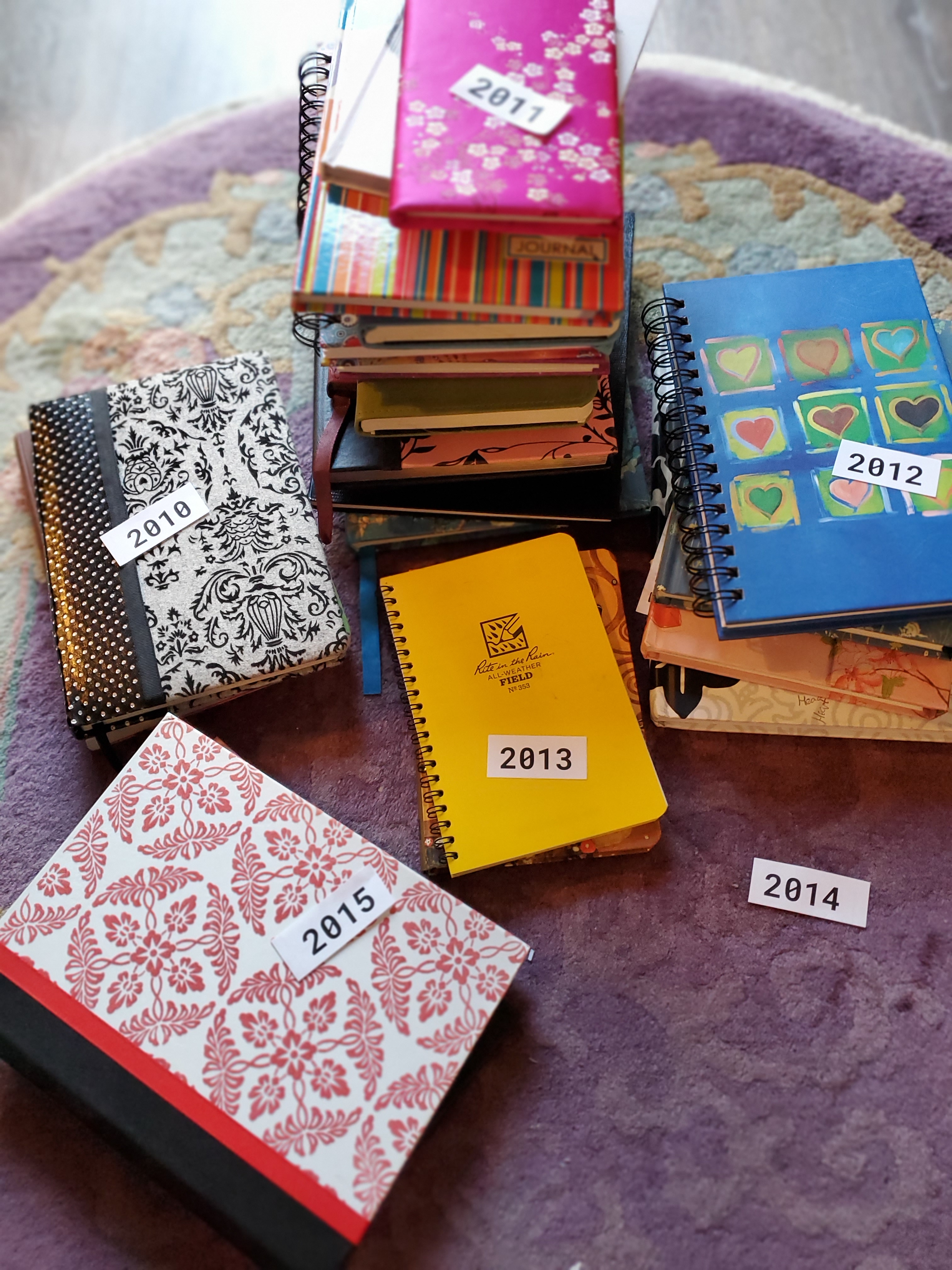
Moving back into my studio was a sort of mix of manual labor and thoughtful work and careful selection. Now that it’s finished, I can’t fathom why I stalled for so long. I find myself returning to my studio again and again, thinking about creative projects. I’ve rekindled my eagerness to finish a particular manuscript that has been languishing in a file on my hard-drive for awhile – almost a decade. Long overdue, and I did not understand that two things were holding me back: 1 poem I had included that I had serious second thoughts about, and those journals tucked away in a bin. Funny; I took care of the journals, and now project after project that had been stalled seem to percolate to the surface for their moment.

What’s holding you back? When will you tackle that?

How much baggage are you dragging along every day? How much can you “just set down” and walk away from? Are there things you could let go of, that you… just don’t? What is that doing for you? (Seriously, you probably wouldn’t cling to some of that sticky bullshit if you weren’t getting something out of doing so, if only the strange comfort of familiarity – which is totally over-rated.)

I’m no therapist, just saying – lightening the load makes for an easier journey. 😉

I sip my coffee and think my thoughts. There’s a garden to plan. A life to live. Love to embrace and nurture. Already time to begin again.

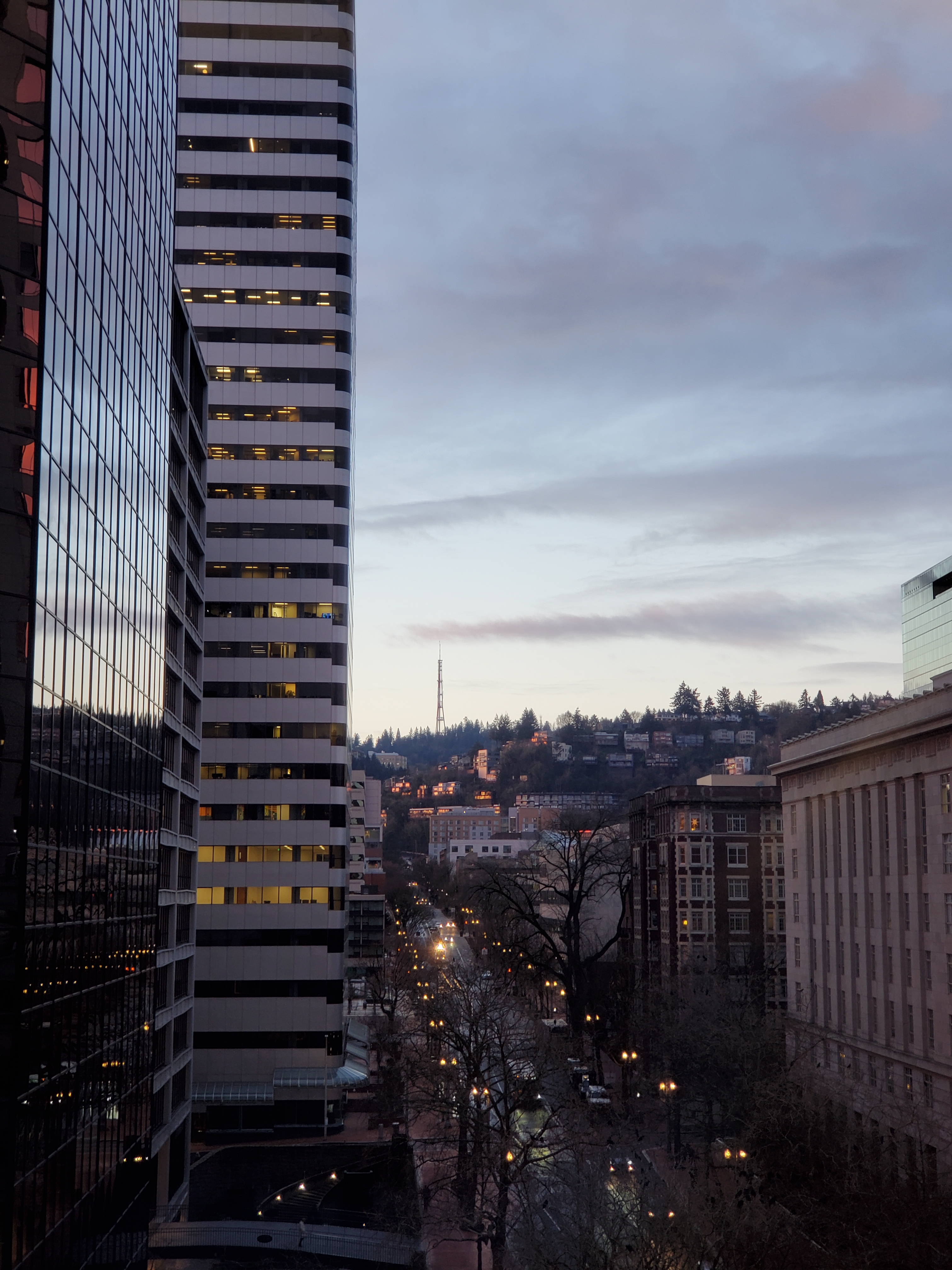
I’m sipping my coffee and thinking about a question. “How do I actually change my perspective?” The colleague who asked the question wasn’t being flippant or obtuse, and the context was work we were doing together. Sincere question. I was stalled for a moment, because for me the answer is ludicrously practical; make a literal change in the angle of view, or distance from which something is observed, or… I think you get it? Something as simple as standing on a chair to see something a different way, or looking out a different window to capture a different view… right?

Looking out one window of the office, onto a city I’ve known for 42 years.

We continued the conversation as we walked to the break area for coffee. We looked out other windows, still talking about how to shift perspective, metaphorically and for real.

Maybe it’s only been 22 years? Depends on what years “count”, doesn’t it?

Different window, different views… same city. So, different perspectives on this one place. Handy to have a real-life demonstration available. Lovely morning for it. We get pretty easily locked into a point of view, or some very specific limited understanding of the world or our circumstances based on our perspective. Being able to shift our perspective and “see things another way” really matters for things like communicating with others, being compassionate, and effective problem-solving that presents an inclusive solution to a problem that affects many different groups. We’re not a homogenous mass of flesh all of one mind; we’re individuals.

There are so many ways to look at something.

I sip my coffee and consider my perspective – then and now. Even those differences can provide new perspective. I certainly don’t see the world quite the same way I did when I was a woman in my 20s, 30s, or 40s. Time passed. I experienced more of what the world had to offer, and learned and grew through my experiences and decision-making. It doesn’t take standing on a chair, or looking out a 10th floor window, to take advantage of this mortal lifetime to reflect on changes in perspective. It’s hard not to change one’s perspective. How much effort do people have to put into to clinging to a poor understanding of an event, or a mistaken assumption, or limited perspective to “stand still” and “never change”?

It may be as easy as a chair or looking out a different window, or asking a new question of the person in the mirror. Change is. Our perspective easily shifts with our changes – if we allow it, and take notice. The trickier bit, I guess, is constructively changing our perspective to give us a “better angle of view” on something we don’t necessarily experience or understand from our own circumstances.

I think on it for a while, sipping my coffee on a rainy chilly winter morning. Would my thoughts be different on a summer day?

My eye falls on my to-do list. I smile; I’ve worked the list down to just one or two inconsequential tasks, and an errand. Not bad. It won’t stay that way; I’m always adding to it and working it. It’s just a list of reminders to change something. My coffee is cold now, and I could use a manicure. It’s far too early in the morning to get a manicure; it goes onto the list. That’s how it works. LOL

…I could use another cup of coffee. It must be time to begin again.

I’m on my third coffee this morning. I slept poorly. My Traveling Partner slept poorly. I slipped away early in the morning hoping he would be able to get some better sleep, but that didn’t work out ideally well. I am sitting in the studio, drinking coffee and considering the causes and the potential outcomes, and wondering how best to be helpful.

“Being considerate” may very well be one of the most powerful skills (and practices) that a person can bring to social relationships (of all kinds). I have found it sometimes a bit difficult to define “consideration” – in spite of placing it high on my list of things to look for in relationships. I see people who are “considerate” practicing deep listening, explicit expectation-setting, skillful boundary setting, asking clarifying questions, testing their assumptions, yielding their natural desire to be “right” preferring to be kind, making an explicit effort to refrain from “centering themselves” in every circumstance or conflict, and being very comfortable making a prompt apology when another person points out a transgression. That seems like a lot to manage, but it really does all map to “consideration” – as in, genuinely considering what those around them are going through or may need.

Let’s be clear on one point; I don’t see considerate people being doormats or open to being abused or mistreated. They use boundary setting and expectation setting with great skill and comfort. They consider their own needs along side the needs of others, and make a point of practicing good self-care, too.

Lacking fundamental consideration leads people to casually mistreat others without intention – and often without noticing, and sometimes following-up by callously doubling-down on that mistreatment by attempting to deflect blame (by way of excusing their actions as “unintended”). Doesn’t really “make things right” to do things that way, and feels still more inconsiderate. People who are inconsiderate are by far more common than people who are considerate! It has become socially “normal” to see (or have to accommodate) inconsiderate behavior from others. People are busy. Self-involved. Dealing with their own shit. Struggling to heal trauma. Uneducated about the impact their choices/words/behavior has on others. Unaware how much difference consideration can make. There’s a lot going on with inconsiderate people. Most of it is even shit everyone has going on in life. One thing that isn’t going on with inconsiderate people; they are not being “considerate” (probably a huge timesaver, I don’t know…).

Consideration and considerate behavior isn’t “natural” to human primates; we learn it from our social group(s) – and therefore must teach it to our companions, explicitly. Children generally get taught “sharing” – a part of consideration. Every element of consideration probably needs to be explicitly taught. As a culture we’re clearly falling down on the job, there, based on the general rise in inconsiderate behavior, basic rudeness, and prevalent violence. I’m pretty certain that very considerate people are likely less prone to violence. It’s something to think about.

Today, I’m struggling with “my nature”; I tend to be very considerate (of others), but also tend to fail myself on the self-care and boundary-setting side of things. Knowing my Traveling Partner did not sleep well, I consider what I can do to be helpful, or to at least minimize the potential for stress or conflict in our relationship due to the both of us being fatigued and in pain. It’s complicated. What does he need? What does he want? Can I provide those things? Is guessing at them wise? What about me? What do I need, myself? Can I meet his needs and my own? When do well-intentioned inquiries about what he needs become invasive or pestering? How do I prevent my own boundary and expectation-setting needs from being swept aside in the pursuit of a gentle day together (under difficult circumstances)? What is reasonable, and what is excessive? How far do I take “not taking things personally” before it becomes entirely necessary to “push back” or point out a boundary – and how do I do that gently enough to also avoid sounding “bitchy” or unreasonable?

My anxiety simmers in the background, and that’s not at all helpful. Consideration, like “mindfulness”, is something that takes quite a bit of actual practice (at least for me). It’s not my “default” human behavior. It is, however, something I value quite a lot – enough to keep practicing. Enough that it matters to achieve mastery – and balance.

It’s a new day. There are opportunities to be a better person than I was yesterday. There will be verbs involved, and practice required. My results will no doubt vary. It’s a good time to begin again. 🙂

The morning is off to a difficult start. I woke in pain after a restless night. My Traveling Partner also woke in pain, and considering every time I was awake, he was also awake, I’m reasonably certain both of us have had less than ideal sleep. I make coffee. We don’t manage to enjoy it together – we aren’t enjoying each other very much this morning. While this does suck, it’s a temporary thing, and it will pass. I focus on other things.

I seek to be kind with my words, and to speak gently.

I already suspect today is one of those days on which whatever my best effort happens to be, it may fall short of ideal. I’m tired. I’m dealing with unmanaged pain. I’m aggravated. Is it me? Is it “us”? Is it just one of those very impermanent situations that will pass when it passes and simply be forgotten? Is it more important than that? I fuss quietly to myself, sip my coffee, and work on breathing through it, and letting it go. I work on not taking it personally. These are “practices” for me because they do indeed require practice. Steady. Regular. Repeated.

Kinda feels like I’m almost always standing in hot water. It’s frustrating, and this morning it is holding me back from enjoying this moment.

I breathe. Exhale. Relax. I focus on “now”, bringing my mind back to my breath, again and again. It’s something. Is it enough? I find myself wondering what conversations my Traveling Partner has with himself on mornings such as this. I wonder what he does to get past the difficult moments of life with a brain injured partner with PTSD. Doubtless it is not always an easy experience… How does he avoid fusing with my experience? How does he nurture and soothe himself?

Tomorrow, I am taking a break for myself, and driving out to the coast to walk on the beach, and listen to the wind and the waves, and be still and solitary for a little while before returning home. Another breath. Another moment to relax. I contemplate the drive without much eagerness in this particular moment right here. The morning is a difficult one, and I’m struggling to distract myself.

Human primates seem always to be trippin’ over something or another. Emotions are part of the human condition.

I breathe. Exhale. Relax. I turn to respond to my partner when he opens the door to ask me to empty the little trash can in my studio; it’s trash day. He’s preparing to take the bins to the curb for pick-up. Life is… so ordinary. Difficult moments are only that, moments. They pass. They are finite. Sure, they recur. My results definitely vary. I often find myself wanting or needing to begin again. I keep practicing, and instead of “looking for signs” that things are somehow worse than a moment gone wrong on a difficult morning, I let it go (again).

We put caution signs everywhere… but we create the hazards, too.

I am reminded that we make most of our own drama, and routinely blow small shit way out of proportion. Human primates are messy, complicated, and emotional. We aren’t as smart as we think we are. We’re prone to reasoning poorly, and reacting emotionally to circumstances in which our emotional reaction lacks value or utility – and expecting our emotions to have all that going for them is asking a lot of feelings. “Do not touch the edges of this sign.” No kidding.

Also? Stay on the path. Breathe. Keep practicing.

Begin again.

Sipping my coffee and listening to the rain fall. Artificial rain…although… it is raining outside this morning. This particular video also has the sound of a crackling fire, a river flowing nearby…and honestly, sounds rather like a rainy day here, in my own living room, on a day when the creek is flooding. It’s a relaxing soundscape, and tends to push distractions out of my immediate awareness very well.

…The relaxing, soothing, comforting, background soundscape tends to be very helpful with managing my anxiety, which has been coming and going rather a lot the past week or so. I could have expected it, I suppose. When my values and my circumstances feel as though they are in opposition to each other, or somehow at odds, I don’t feel “comfortable”, and the longer it goes on, the more my anxiety increases in intensity, and the frequency with which it surges into the forefront of my consciousness also increases. It’s an “early warning system” that there may be a decision-making point coming up very quickly, or that the time to reflect on things and make other choices may be upon me. I could “fight it” with soothing sounds and do nothing more. I could meditate regularly, “accept my lot in life”, and struggle with the anxiety and discomfort – or attempt to medicate it away – and settle for quiet misery.

…Or I can acknowledge that I am unhappy, seek to determine what the primary cause of that discontent may be, and consider other options… this is particular effective if, after all that, I’m prepared to choose change. I mean… maybe the options aren’t really an improvement? That’s certainly a scenario that comes up now and again. I’ve often found that getting to that place where I can critically consider and factually determine that the present options don’t result in a clear likely improvement also serves to reduce my anxiety – it’s more about giving the matter real thought, and allowing myself the consideration and respect required to resolve my discontent with action, where action would do so.

I would use the example of working a job that isn’t ideal. Maybe it really is a poor fit, and making a change would be an improvement? Maybe the available options would not actually present a legitimate shot at the desired specific improvement at all, and would therefore be of no real use? Maybe the options are “more of the same” and “more of the same-r-er”, and time would be better spent in improving skills, and investing time in other endeavors during leisure hours? Maybe it really is time to move on to some other thing? I’m not a fan of reacting in the moment with drastic action built on an emotional moment. Personally? I like self-reflection. I value introspection. I seek self-awareness. I’d ideally prefer all of my decision-making be built on those qualities, and a hearty helping of perspective, self-respect, and non-attachment, besides! 🙂

“Having it all” comes in many forms. What do I really want? What matters most? Where does lifelong fulfillment lie on this path? Am I headed down a path that even leads me in the direction I hope to go? No map.

I’m sipping my coffee and listening to the rain fall. It’s not relevant that the sound of it “isn’t real”, particular when I’m seeing the rain fall beyond the window. What I see and what I hear are well-aligned. Isn’t there real value in also having my circumstances and professional values also aligned? I’m just saying; I have choices. There are verbs involved. My results may vary…

…And I also get to begin again. 🙂