Archives for posts with tag: vita activa

“Slow down”, I reminded myself. It is a very foggy morning. Visibility is poor on the highway, and in the darkness it would be far too easy to overlook a deer or a person attempting to cross the road. There was no traffic at all, only fog, and darkness interrupted periodically by streetlights.

The phrase “slow down” resonates in my thoughts as I drive up the highway to this morning’s trail of choice. It becomes a song in my head. It’s an old old hit song, full of optimism. I sing out loud as I drive, surprised to remember the lyrics.

The reminder to slow down continues to resonate in my thoughts, rippling beyond the obvious practical meaning and through other thoughts, washing over the recollections of other experiences. Sometimes I “go too fast” and get swallowed up by imagined urgency, or distracted from enjoying life by self-inflicted busy-ness. I reflect on that as I drive.

I get to the trailhead before daybreak. It’s very early, and very quiet. The fog on the marsh obscures my visibility even more than the darkness, and my “view” is limited to the bobbing circle of light cast ahead of me by my headlamp. Headlights of passing cars on the highway adjacent to the edge of the meadow and marsh sweep past casting strange shadows in the fog. Several times I think there is someone else on the trail ahead. There isn’t. I’ve got the trail to myself this morning.

I get to my halfway point, still wrapped in darkness and fog. I sit quietly, enjoying the stillness and solitude. I meditate. I wait for daybreak. I’m not in any hurry at all, and that feels good. Restful. Luxurious. I breathe, exhale, and relax, and contemplate how best to communicate the practical value of slowing down. I’m not suggesting do less, it’s a more subtle consideration. It’s more about presence, awareness, and deliberate mindful action, and refraining from “filling space” with motion and task handling just to stay busy, or to overcome boredom.

…Go ahead and be bored now and then, it’s probably good for you…

… Better than doom scrolling the news, by far.

Daybreak comes. The sky shifts slowly from the undefined foggy darkness to a hint of a paler bluer gray in the sky, the oaks on the hillside on the other side of the trail are silhouetted, a feathered dark edge where the sky begins. I breathe the fresh chilly autumn air. The marsh has a very specific scent of its own. I don’t have words to describe it, and I enjoy it wordlessly. I hear a noise and look down.

Near my feet a young raccoon has approached me unnoticed. I manage to avoid being startled, but hear my own voice call softly, seeming unnecessarily loud in the gloom, “Oh, hey there! Don’t have rabies, okay? You should go back to your mama, Kiddo.” The youngster stands briefly on hind legs, looking me over curiously, before dropping back to all fours, turning and waddling quickly away, into the taller grass between this bit of fence I’m sitting on, and the marsh pond beyond.

I sit awhile longer, grateful for this quiet contemplative time to myself. Vita activa may fulfill a sense of purpose (or one’s bank account), but it is vita contemplativa that I personally find most valuable for finding that sense of purpose in the first place. Our mortal lives are finite and our moments precious and few, but trying to stay busy and occupy that time every moment with purposeful action risks missing out on so much creative potential and pure joy in living some moment, just as it is. I can’t explain myself adequately well, on the value in daydreaming, in boredom, in stillness and in slowing down. I can only do my humble best with the words I have. Instead, I share some other words, more skillfully crafted. (Do you ever click the links? Are you ever surprised by what you discover?)

Ichi-go Ichi-e. Be here now. Breathe, exhale, relax. Live the life you have, while it lasts – we are mortal creatures. Be present in the moment, awake and aware. This too shall pass… it’s all quite temporary.

We become what we practice. What are you practicing? Are you taking time to really live? Put down the device. Go outside. Read a book. Spend time with a friend. Daydream awhile. Slow down. Enjoy the journey.
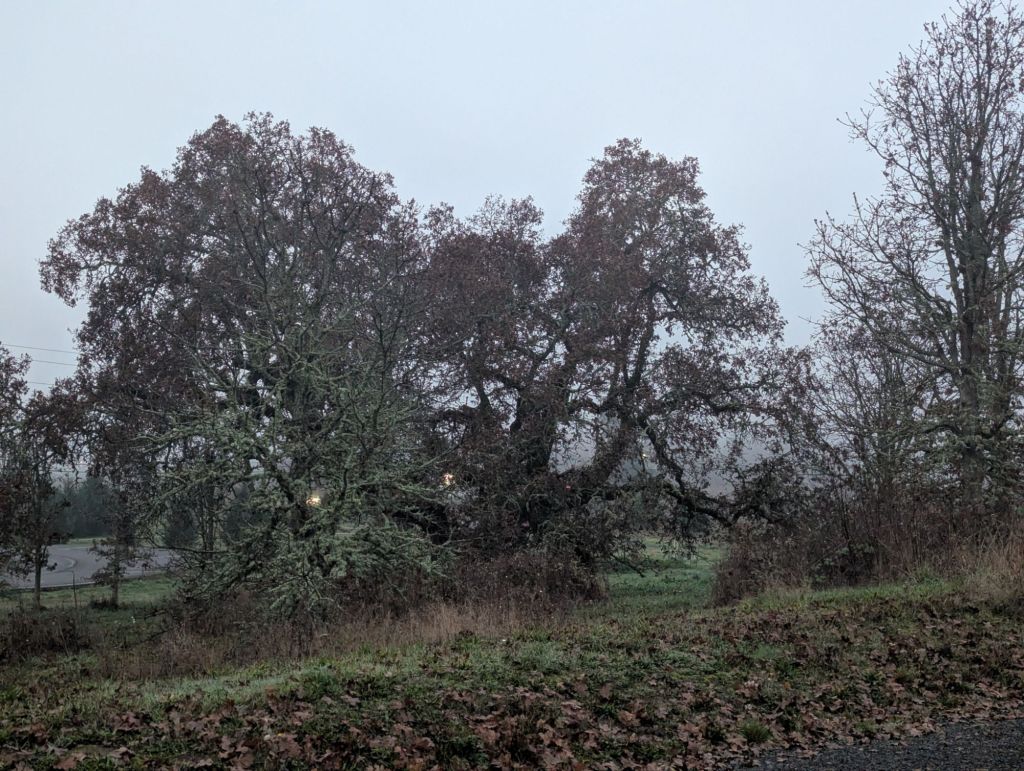
An autumn morning, a trail, a journey.

I grin to myself as dawn becomes a new day. A misty rain falls on the foggy marsh. I am wrapped in contentment and a soft merry joy fills my heart. It’s a good starting point to begin again.
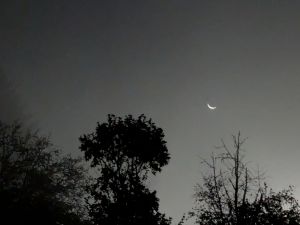
I got to the trailhead early. Before the sun. Before dawn. Before daybreak. In the chilly darkness of an autumn morning, a mist gathers, moving up from the lowlands of the marsh and the riverbank. A slim crescent moon rises, looking like a single half-closed eye in watchful meditation, above the mist.

Predawn darkness at the trailhead.

It is a good time for thinking and for meditation. As the moon rises, I reflect on useful ideas I have picked up along my journey, each uniquely worthy of guiding me on my way, like sign posts, or streetlights. I take a moment to jot them down, carefully putting them in alphabetical order for no particular reason.

Amor Fati is, for me, a useful idea in spite of my lack of conviction with regard to the possibility that anything at all is or is not “fated” to be as it is. For me it carries a sense of recognizing that circumstances are what they are in some moment, and allowing (encouraging) a certain sense of acceptance, generally, and living within an accepting context, on life’s journey. I don’t carry any sense that I am “doomed” to some particular outcome – change is – only that even in the midst of change, acceptance can provide a comfortable foundation to rest upon, before beginning again.

Gnothi Seaton – know thyself – an idea with so much history behind it, it’s hard to call it an eye-opening realization. Seriously, though? How can we change who we are, if we don’t know who we are?  How can we grow to become the person we most want to be, if we don’t know who that even is? How can we live our values, if we don’t have a clear understanding of what we do value?

Gratitude as a practice has become incredibly important to me. It’s one of several practices I practice that is built on a simple idea. In this case, the simple idea is that gratitude tends to crowd out anger and similar negative emotions, creating a more positive experience of life, even in stressful times. Gratitude helps build emotional resilience and reframes difficult experiences in terms that tend to promote peace, compassion, and understanding. Gratitude also feels good and satisfies something within me.

Ichi-go Ichi-e is the unrepeatable, unique nature of each precious finite moment, and is a particularly powerful idea for me. Each singular moment of our mortal lifetime is also another opportunity to begin again, to do better, and to be more present.

Impermanence is one of those ideas that has layers of meaning and usefulness. I meditate on impermanence often. Change is. However reliably certain some condition or experience seems, change itself is more reliable and more certain. We are mortal creatures, living our short lives in a finite universe of constant change. Impermanence is the sort of idea that can cause a person tremendous anxiety – or heal it, depending, I suppose, on how it it viewed, and whether it is accepted.

Memento Mori is an interesting idea, a reflection on mortality, a reminder that our time is brief, and that our mortal life will inevitably end. There is (as of 2025) no escaping death. Will the life we choose to live be worth our efforts? Will we be remembered – and for what? Life itself is characterized by impermanence, and our journey is the only destination we have, as the grains of the sands of time trickle through the hourglass. Even knowing that – maybe especially knowing that – we live and choose and grow and continue one day after the next, until the days run out. Which they definitely will.

Non-attachment, like several of these ideas, is associated with Buddhism, and other religions that value contemplative and meditative practices. It is a caution against clinging to expectations, desires, or worldly things. It is the face of a coin for which impermanence is the reverse. When we embrace change and refrain from clinging to some specific outcome, we free ourselves from a lot of drama, sorrow, struggle, and emotional pain. It goes hand in hand with ideas like “letting small shit stay small” and walking away from unpleasant (or damaging) people or experiences.

Vita Contemplativa is the inverse of Vita Activa (also a useful idea, but sadly perverted in a busy modern world, becoming “grind culture” and abusive overfocus on work to the detriment of self). The 21st century philosopher Byung-Chul Han wrote a book by this title, in praise of inactivity as a vital function of living well. Turns out, we’re so incredibly bad at living a contemplative life, or even at incorporating contemplation, self-reflection, and meditation into our daily lives that I couldn’t find a single really good source of information to link for this one, other than to Byung-Chul Han’s book. We put a lot more emphasis on productive action in life and society, even to the point of illness, chaos, and destruction. We over value momentum and ambition, and decry thoughtful reflection as”lazy” or a “waste of time “, and tend to punish the daydreamers and peace seekers among us. That’s pretty sad, actually.

A new day, well-suited to thinking thoughts and walking in solitude.

Day comes. The mist envelopes me on the marsh trail. I am alone with my thoughts, wrapped in contentment. I let the useful ideas stack up, layers of self-reflection, practices, and incremental changes over time. I can easily say I am in better place as a human being than I was 15 years ago. Strange to see the journey behind me in such clear terms, illuminated by a handful of useful ideas.

(“It’s not a religion, it’s just a technique…“)

The time I’ve spent along the way really reflecting on where I’ve been and where I’m going – if I even know – has never been “wasted time”. Some of my most precious moments have been spent in contemplation. Meditation has proven itself as a powerful healing practice (for me). I didn’t know it would be, when I set off down this path…

… And it’s time, again, still, and already, to begin again. I don’t know where I’m going, not really, but I’m definitely getting there. The journey is the destination.