Archives for category: Logic & Reason

I just finished reading After the Ecstasy, the Laundry by Jack Kornfield. It’s a worthwhile read on the topic of mindfulness. Interestingly, I happened upon an article about “why mindfulness isn’t working for you”, while sipping my coffee. The contrast was worth making a moment to consider.

Why would mindfulness practices “not work” for some people? I read on, and get to the part about mindfulness potentially being “harmful” for trauma survivors… which puzzles and saddens me; I’m certainly one of many trauma survivors wholly supported and helped by mindfulness practices – they saved my life, in quite a literal way.

I continue to contemplate these positions, so at odds with each other. Helpful vs harmful. Effective vs ineffective. Huh. I consider the following points that seem relevant:

  1. Mindfulness and meditation were only helpful for me after I found a specific style of meditation that was a good fit for me personally; it requires a commitment to practice, and it is helpful to select a practice that I’ll actually practice.
  2. “The way out is through” – I didn’t benefit from meditation and mindfulness practices because they were emotionally easy on me; a large part of the benefit was that these practices helped me process old trauma, and find my way to the “other side”. Nothing about that is emotionally easy, and there was (and is) work involved. Emotional work requires effort, and a willingness to do it.
  3. Mindfulness is not a “cure-all”; these practices are effective for what they are effective for, and only that. Beginning a mindfulness practice, or meditation practice, expecting that it will “fix everything” seems as silly as expecting to put on new jeans and be a different human being.
  4. Read #4 again. Meditation is not an escape from our self – or our life, or our need to do self work. We remain the person we are, with the challenges we have, and possibly still lugging around all our baggage, which we would still need to actually work through (if we want to let it go).
  5. Mindfulness and meditation are not “easy” practices. I mean, the fundamentals can be quite simple, for sure, and it is highly likely that those hurting souls looking for a fast fix may drop by and give meditation a try, but it’s also likely they won’t commit to a consistent practice. It’s not that the practices didn’t work, in that instance, let’s be real about that. We’re not all willing to commit to a routine or practice, in the first place.

Effective. Safe. Low cost. Yes, there are verbs involved (omg, so many verbs), and yes, there is a requirement to be consistent – and maybe even studious, if we’re serious about it. (Check out how many books on mindfulness are on my reading list!) Does it have to be hard? Well… we get out of life, frequently, a return consistent with our invested effort, in some regards. Certainly this is one of those, but a futile struggle with something that isn’t working out for you seems rather silly. If meditation isn’t working for you, find something that is? Or study why it isn’t. (Shit. More verbs. 😉 )

What are you really looking for? Are you on the path toward that goal? Those are good questions to ask, I think. If “meditation isn’t working”, it may be worthwhile to give a moment of thought to whether it was actually the most appropriate tool for the job you went into it expecting it to do. Sometimes, we grab the wrong tool, and make the job at hand much more difficult. Ask what you’re really trying to get done in the first place; doesn’t matter what tool you pick up, if you don’t know what you’re trying to get done, it’s going to be harder to finish the job.

I finish my coffee. I begin again.

It’s sometimes necessary, I find, to accept what is. No, I mean, really, really push past the clinging and exasperation, the disappointment, the frustration, all of it, and truly accept the “now” I find myself in, and do so quite fully, without denial or blame. It’s not always easy. Words are easy. Verbs take effort. Reality may allow me to delude and deceive myself awhile, but… reality always wins. It is.

…Let’s set aside the also real reality and true truth that we make up a lot of our experience in our own heads, and much of what we “believe” about our circumstances is in no way actually supported by reality. It’s made up bullshit we refuse to let go of. Truth. Mull it over.

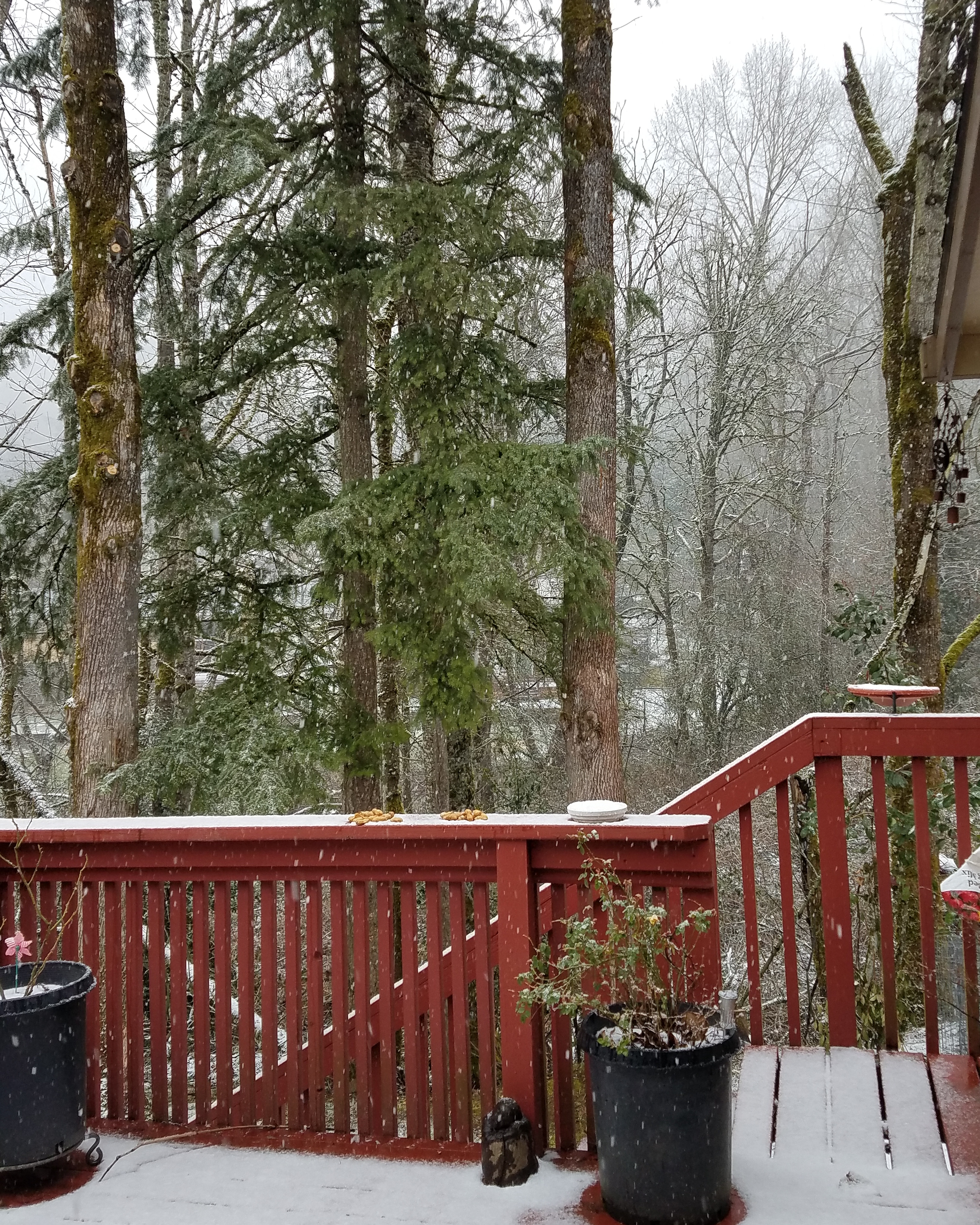
Reality always wins, and most harshly, reality wins in some uncomfortable ways when I refuse to accept things as they are, without clinging, without attachment, and without self-deception. It’s snowing again this morning. Well, it was. As has been the case for a handful of days, now, our weird winter weather continues; snow during the wee hours, enough to dust everything and coat the roads. By noon, it will have all melted away in the cold winter sunshine. I’ll head home in the winter chill, across dry pavement, perhaps a hint of rain in the sky. The cycle will repeat. Schools have been canceling on days without any actual snow. Businesses have been closing, or opening later, on mornings with utterly dry pavement. It’s… strange. It is also 100% of what it is, and nothing more; no amount of argument or discussion will change it. Reality doesn’t bow to opinion. Ever. My feelings about the snow are not relevant to the facts, themselves. Reality is not an emotion.

I think over the day ahead, without much regard for the weather. I expect it will be more of the same, as it has been; my expectations still don’t amount to facts, truth, or reality. I contemplate my commute, and think ahead to spring, and maybe handling it differently. Park closer to work, spend less distance/time on the light rail or bus, walk more. The walking more sounds so lovely… I already get more walking than at my last job. I’m not sure what changed besides the address that frees me to do so… a different mindset. Did I make that change? (Probably.) Is the role that different? (It is.) Is the location more enticing for walking around? (Definitely.) Choosing change comes with a ripple effect; when I have chosen wisely, so many details are changed for the better, and when I have chosen poorly, quite distressingly similarly, many small details may change in ways that affect my experience in less pleasant ways. Choosing wisely is worth slowing down for. Fully considering the changes I choose, and the changes those changes may cause, is worth making time for. Change will come, regardless, and choosing it skillfully, navigating life instead of bobbing haplessly along its currents, can certainly alter the outcomes.

Well… here I am. Another day, another beginning – and more change to choose, more choices to make, more life to live. It’s already time to begin again. 🙂

We are each having our own experience. As true in this calm moment as in any moment of chaos. 🙂 I sip my morning coffee, already cold because I got caught up in listening to music, and chatting with a friend online. I don’t mind. The music – and the friendship – are very much worth my time.

I sit here contentedly musing over the conversations of the week behind me, and the evening, last night. It was an excellent first week at the new job. It resonates pleasantly in my memory. My Traveling Partner and I worked out plans to do with benefit selections, and changes to the budget for the year to come. No stress, anxiety, even though the topic was definitely to do with money. I smile and let myself recognize the growth that experience implies – and the healing. I’ve come along way with myself, and savoring that awareness is, itself, a form of growth and healing. 🙂

At one point, we decided to watch a couple of videos that intend to contrast “get ahead habits” with “fall behind habits”. Both had excellent content, in some regards. Both were also deeply flawed, depending on context, perspective, and framing. This presented a challenge for me; I was viewing them from an awareness of other experiences that made some of the points in these videos… problematic. For one thing, I’ve told you that these were videos about getting ahead versus falling behind, but the content creators don’t actually frame them up that way at all; they say the videos are about “poor people” versus “rich people”. I found that, frankly, highly objectionable, and it kept getting in my way of my ability to listen deeply to the actual points being made, which in several cases had real value. More than anything, the implicit definition of “rich” as de facto equivalent with “successful”, “deserving”, or “good”, and of “poor” in a litany of negative ways presented with a shaming tone was super aggravating. The videos were purposefully made with a very particular demographic in mind; people who want to get ahead in life, from where they are right now. Rich versus poor is a common enough false dichotomy in our culture, and it’s also not uncommon to blame poor people for poverty, or to treat rich people as though they are also ethical, and deserving. I just also think it’s fucking mean to take that approach.

Here’s the thing, though; the content has value. The points being made were not in error, generally. The points were merely drastically over-simplified, lacking in nuance, and stripped of context – in order to make those points more obvious to an audience that may not understand. The terms “rich” and “poor” weren’t being defined with any clarity to provide context – rich is rich, and in the videos no distinction is made between wealth gained through ill means (fraud, theft, exploitation), inheritance, or good fortune, and wealth gained through skillful endeavors. Actually, and I think it is what was annoying me most, the videos very carefully imply that all wealth gained is a goodness, and eschew any discussion of ethics. Same with poverty. The content providers allow an implication that enduring poverty rests on the decision-making of the poor, without even a hat tip to misfortune, institutional racism, or the very real limitations our culture has placed on people’s access to the tools and knowledge that might ease their scramble from poverty to… not being held back by poverty. The content only has two options: rich or poor. No discussion of middle-class success… or any discussion of success versus wealth – conflating cash hoarding with success in life tends to lock out viewers who might see success quite differently than a mountain of cash.

I watched them again this morning, and considered the points from many angles, allowing myself to “talk back” to the faceless narrator. I got more from them the second time through. I still think the content could have been more nuanced, deeper, more authentic, and more informed by explicit discussion of ethics, success, and happiness “metrics” that are more legitimate than a bank balance. I ask too much; the content provider knows their trade. I am not their audience – I am an eavesdropper gleaning something useful from a discussion that doesn’t have much to do with me, really. The target audience may not have the will or interest in also learning to live well, behave ethically, be their best selves, and treat others (and the world) well. They aren’t there yet. They just don’t want to be poor. An understandable position to take, and I hope they succeed at escaping poverty.

I hear my Traveling Partner stir in the other room. The weekend is here. I smile and finish my cold coffee. It’s time to begin again. 😀

Sipping coffee on a quiet President’s Day holiday morning, and contentedly relaxing, letting go of baggage and bullshit lingering from jobs past, preparing for a future that begins in earnest, tomorrow. (Doesn’t it always?) I breathe. Relax. “Fuck my bullshit,” I think, smiling.

This seems relevant today (and many other todays as well). Far more experienced and expert words than I could offer. 🙂

I’m comfortable telling my own bullshit to fuck right off. If I don’t, I’m sure someone else will, but… what would I learn from that besides rejection? It’s too easy to excuse bullshit because someone else called it out, and the resulting feelings of defensiveness, hurt, rejection, and possibly resentment and anger, will quite likely blot out my ability to easily recognize that there is real truth to it. It’s important, I find, to be awake to my own bullshit, as much as possible, and do that work myself. It’s peculiarly far less lonely. 🙂

While I’m on about it… fuck your bullshit, too, damn. Can you do a little something about that? (Yes, you can. Choices. Verbs. It’s a lot of work I know.) I’m being somewhat playful, but also quite serious and purposeful. When was the last time you did a serious self-inventory? Who are you? Where are you headed in life? Are you wasting your resources and potential as if there is no future? Are you playing a grand game of Let’s Pretend and failing to understand how very much control you actually do have? Are your thinking errors preventing you from being emotionally and physically well? Are your addictions degrading your quality of life in return for a few minutes of something like pleasure? (Fine, fine, you’re not addicted, it’s just something you do… whatever. Fuck your bullshit.)

Seriously. Fuck your bullshit. Let it go. Change something you don’t like about yourself – because you don’t like it. Change your circumstances, if they suck. Seriously. Make choices. Use verbs. Don’t just party through your heartache or the wreckage in your head that’s holding you back. Educate yourself. Read a fucking book. See a damned therapist. Make every possible effort to be the person you most want to be! This is your life. Live it well, for fucks’ sake – because it is yours.

Why? Well, damn – because it’s what you want. Did you not already catch on to the fact that when what you want (of yourself, and of your life) is very different than what you are providing yourself, a deep despairing unhappiness can set in, an ennui that can destroy your ability to act – or to care – leaving you vulnerable to yet another evening/weekend/week/month/year of going… nowhere. Stress that never ends because you never choose in favor of your own long term interests and needs. Are you on a path that leads somewhere? Are you “wandering purposefully” seeking a greater truth? Or are you sort of just… killing mortal time? You could likely do better, for yourself. Your will to do so will matter a great deal. There are verbs involved. It’s a lot of work, and at least initially (maybe always, just being real; there’s work to do), damn little in the way of obvious pay off. It takes time. Incremental change is slow.

Anyway. What I’m saying is; this is your mess, you clean it up.

…And also? Fuck your bullshit. Damn.

…And also?…

Begin again. ❤

It’s come up a number of times as I transition out of this job, and certainly it has come up any number of times, an uncountable number of times, in life, generally; we don’t know what we don’t know. None of us do. I certainly don’t know what I don’t know. Demonstrably so. My colleagues don’t know what they don’t know. I can prove it.

I considered writing in detail about the painful professional reminders of this fairly predictable conundrum, but quickly tired of the mundanity of an experience I am living right now, and am also already so over. When we dismiss or diminish the hard-won experience and expertise of a friend or loved one (or colleague), we also undermine their interest in remaining emotionally invested in supporting our needs. That’s just real. Respect, consideration, listening to the answers to questions that are asked, taking time to be thoughtful and studious about information our experienced, expert, associates are willing to share with us, are great ways to demonstrate our appreciation, and to ensure their time is not wasted on us. Time is precious and limited.

Yes, it matters. We don’t know what we don’t know. We can’t. We literally can’t grasp the vastness of the information we just don’t have. Ideas we’ve never been exposed to. The potential negative consequences of the things we do not understand, or are not aware of. Showing consideration and respect for those among us who do know something more, and are willing to share that with us, is just an element of what could be called “common decency”.

Put down your opinion along with your ego for a moment, and be open to the idea that not only do you “not know everything” (easy enough to accept, generally), but also that there are others who do know more (a bit harder sometimes, perhaps). Our opinions don’t amount to knowledge. That can be so hard to accept. It’s still true. You want to be the expert? Gain the experience. Study. Gain the knowledge. Use it. Gain more experience. Fail some. Try things. Study more. Seek credentials where credentials are appropriate. Study more. Use that knowledge. Try more things. Ask new questions. Learn more things. See where this is going? You may have an opinion you feel strongly about, but unless your opinion is validated in some way, and proves to be quite correct, it has nothing whatsoever to do with “knowledge” and certainly nothing to do with expertise. Opinions, however firmly held, do not amount to facts – nor are they an assurance of understanding.

It’s okay not knowing. It predicts nothing about the future state of one’s knowledge or expertise; these are things that can be learned. We become what we practice. You want to be the expert? Gain some experience, seek knowledge. There are verbs involved. In the meantime, maybe get comfortable with the expertise of others. Ask them what they know. Listen when they tell you. Don’t assume that the appearance of ease is any indication that something is easy – maybe it is just well-practiced?

We can’t know what we don’t know – but we can pay attention, be open to learning, be willing to study. And we can begin again. 🙂